OKX Money Stablecoin Yield: One Token Pays 10%, 3.5% or Nothing by Jurisdiction
OKX Money pays up to 10% on USDG. The same token earns up to 3.5% in the US and nothing in the EU, which maps how far each stablecoin yield ban reaches.
The Bright Recap
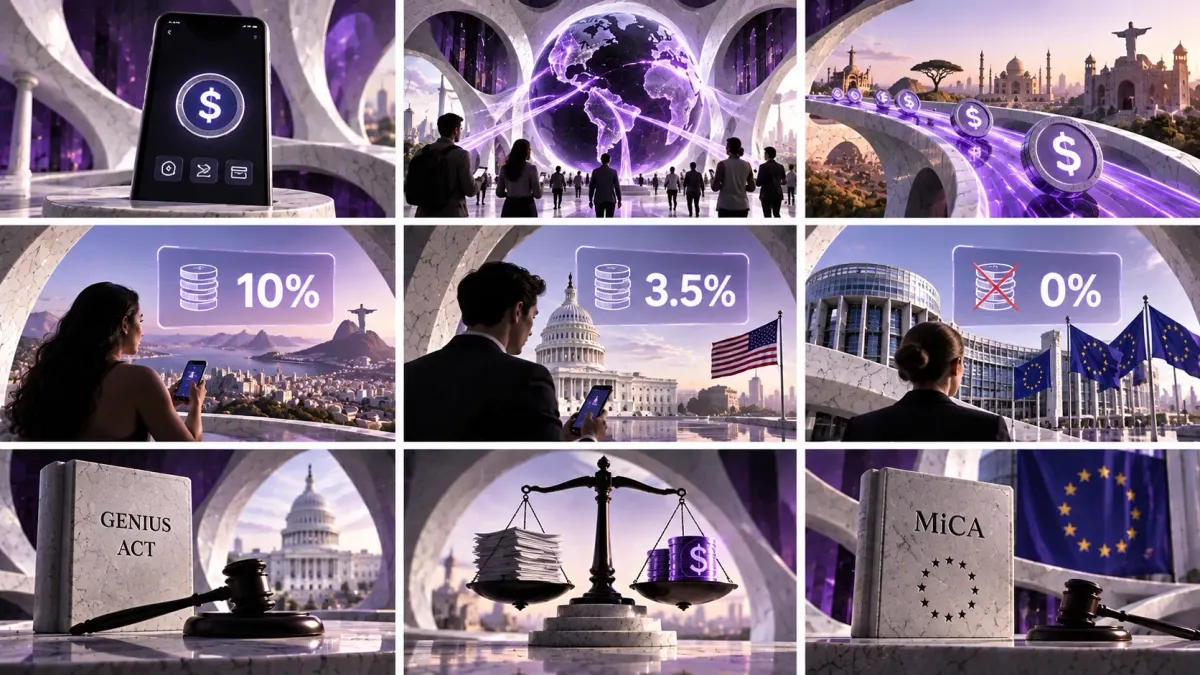
OKX Money pays up to 10% annual percentage yield (APY) on Global Dollar (USDG) balances to savers in Latin America, Africa, South Asia and the Middle East. On the same token, OKX pays up to 3.5% in the United States, where the Guiding and Establishing National Innovation for U.S. Stablecoins (GENIUS) Act names only issuers in its yield ban. It pays nothing in the European Economic Area, where Article 50 of the Markets in Crypto-Assets (MiCA) Regulation extends the interest ban to exchanges. OKX has not disclosed how the 10% is funded.
To know more about this topic, read our related articles:
- Why savers choose digital dollars
- The Senate's stablecoin yield line
- Financial technology explained
- Cantica business reports
Bright Answers
Why does OKX pay 10% on USDG in some countries but only 3.5% in the United States?
OKX excludes the United States from its 10% USDG programme. US customers can earn up to 3.5%, or 4.1% if they trade or hold $100,000 on the platform over 30 days, through rewards the exchange pays. The GENIUS Act's yield ban names stablecoin issuers and does not mention exchanges.
Can EU residents earn yield on USDG through OKX?
No. OKX excludes the European Economic Area from all three of its USDG reward programmes. MiCA Article 50 bars issuers and crypto-asset service providers alike from paying interest on e-money tokens, and it counts any third-party benefit tied to how long the token is held as interest.
A digital dollar held on OKX now earns a different return depending on where its owner lives. OKX Money, the stablecoin savings and payments app the exchange launched on 6 October at its OKX Now event in Singapore, offers savers in Latin America, Africa, South Asia and the Middle East up to 10% annual percentage yield (APY) on Global Dollar (USDG) balances. The same token earns up to 3.5% for most OKX customers in the United States and nothing in the European Economic Area.
The distance between those three numbers follows the law. Each rate tracks how far a jurisdiction's stablecoin rules reach beyond the company that issues the token, and OKX's own terms make that gradient unusually easy to read.
Meet Cantica, the Fin-Tech intelligence system for custom reports to strategise your next business move.
What OKX Money offers savers
OKX Money accepts deposits in over 50 local currencies and converts them into dollar stablecoins. Users can hold USDG, Circle's USDC or Tether's USDT, send money to other users, and spend through virtual or physical cards that carry no currency-conversion markup, according to Fortune's report on the launch. OKX pitches the app at economies where currency swings, thin banking access and conversion fees make savings hard to protect.
The app targets the habit behind digital dollarization, where people living with unstable currencies hold dollar tokens to preserve what they earn. A spokesperson told Cointelegraph that OKX is launching one country at a time to meet each market's local rules, and OKX has not named its first countries. For a fintech chasing those savers, the dollar balance is the product, and the yield is what it pays to win the deposit.
The 10% is a capped promotion
OKX has not published a separate rate card for OKX Money. Its existing 10% programme for USDG runs through OKX Pay and is set out in OKX's own terms. It pays up to 10% on the first $10,000 and 3.5% on anything above that. The terms describe the offer as a promotion with no defined end date, which OKX can end at any time.
The cap pulls the effective rate down as balances grow. OKX's own worked example pays $1,350 a year on $20,000, a blended rate of 6.75% by The Bright Minded's calculation, while a saver holding a few hundred dollars sits entirely inside the top tier. OKX Money adds conditions of its own. The spokesperson said customers move up a tier by keeping a minimum average deposit over 30 days, spending above a set amount in the same period, or reaching a higher loyalty status on the exchange, and that rates vary by region and customer.
The same terms exclude the United States, the United Kingdom, the European Economic Area, Singapore, the United Arab Emirates, Australia and Turkey from the 10% offer. Singapore, the city where OKX Money was unveiled, is on that list. The exclusions apply to OKX's published 10% programme, and OKX has not released a separate list for OKX Money.
In the United States, the ban stops at the issuer
The Guiding and Establishing National Innovation for U.S. Stablecoins (GENIUS) Act bars stablecoin issuers from paying holders any interest or yield for simply holding, using or keeping the token. The text names issuers and does not mention the exchanges that hold tokens for their customers. OKX's US rewards page advertises up to 3.5% on USDG for most customers and 4.1% for those trading or holding $100,000 on the platform over 30 days.
OKX, as the platform, pays that reward, and the statute's text does not name platforms. The American rate is still well under the 10% offered elsewhere, and OKX keeps US customers out of the higher programme entirely.
Why the American gap stayed open
Senate negotiators tried to close it. The Senate's yield compromise in the Digital Asset Market Clarity (CLARITY) Act would have barred digital asset service providers from paying yield tied solely to holding a payment stablecoin. Rewards for active use would have stayed permitted. That provision never became law, because the CLARITY Act failed in the Senate on a 49-50 vote in September.
The result is a federal rule that governs the issuer and a reward market that runs through the platform. OKX's American rate sits exactly in that space.
In Europe, the ban reaches the exchange
The European Union wrote the broader rule. Under the Markets in Crypto-Assets (MiCA) Regulation, MiCA's Article 50 bars both the issuers of e-money tokens and the crypto-asset service providers that handle them from granting interest. The article treats any benefit linked to how long someone holds the token as interest, including discounts and compensation paid by third parties.
USDG circulates in the EU as a MiCA-compliant token issued by Paxos Issuance Europe, so Article 50 covers any exchange offering it there. OKX's terms exclude the European Economic Area from all three of its USDG reward programmes: OKX Pay, the exchange account and the OKX Wallet.
The documented part of the 10%
OKX declined to tell Cointelegraph how the 10% is funded. One source of the money is on the record. The Global Dollar Network, the Paxos partner programme behind USDG, says it returns as much as 100% of the reward income on USDG reserves to the platforms that distribute the token. OKX's terms describe those reserves as US dollar assets attested monthly by an independent third party.
OKX has not said how much of the 10% comes from that reserve share and how much from its own budget. That split is the figure a saver cannot check.
What the 10% means for the savers it targets
OKX describes its target markets as places where currency swings, thin banking access and conversion fees erode savings. In those markets, financial technology products can reach savers who sit outside the banking system altogether.
A saver whose local currency loses value every month gets the main benefit from the fully reserved dollar balance itself. The promotional rate sits on top of that, and the two questions worth asking about it are how long it lasts and who pays for it.
OKX's footnotes have turned stablecoin regulation into a price list: up to 10% in the markets its terms leave open, up to 3.5% where the law stops at the issuer, and nothing where it reaches the exchange.
Editor's note
Every piece published on The Bright Minded goes through careful verification, but mistakes can happen. If you spot an error, have additional information, or want to flag anything, write to rosalia@thebrightminded.com.