
Monero FCMP++: Why Europe's Rules Treat Anonymous Cash and Anonymous Code Differently
Monero FCMP++ would make a payment carry as little history as a banknote. Why Europe's rules treat cash and code differently, and what it means from July 2027.
The Bright Recap
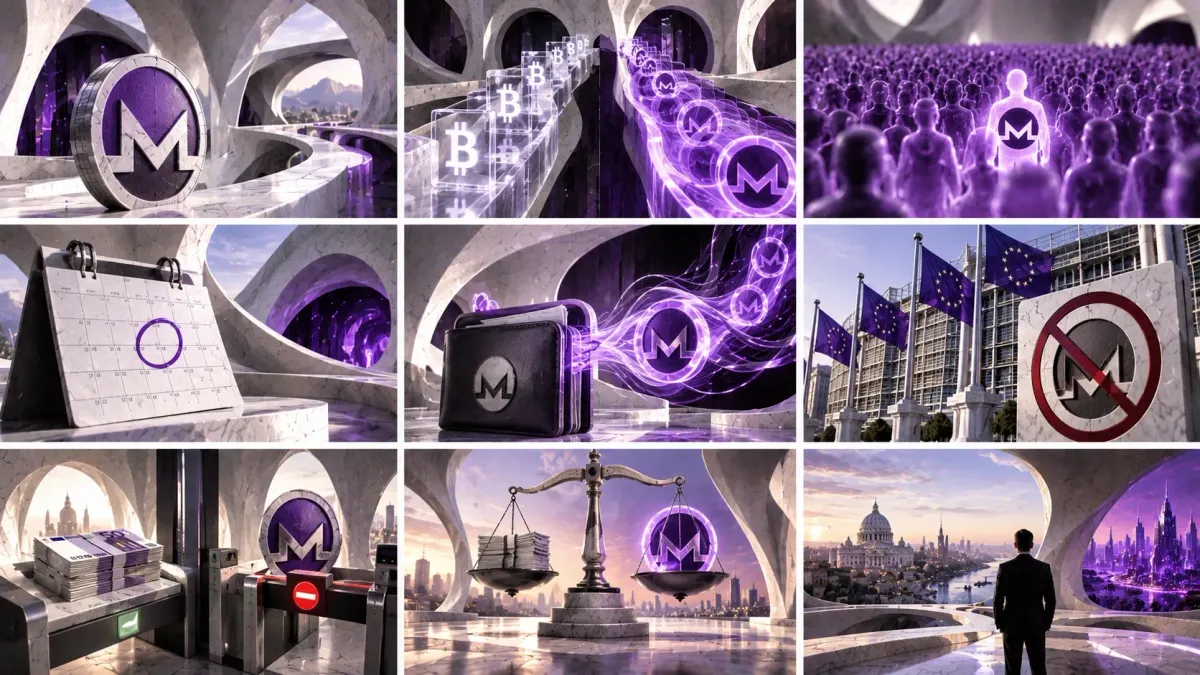
From 10 July 2027, EU anti-money-laundering rules cap cash payments involving businesses at €10,000 and bar banks and crypto platforms from keeping accounts that use anonymity-enhancing coins. Monero's FCMP++ upgrade, scheduled to reach a test network on 5 October 2026, would hide each payment among the whole history of the chain instead of among 16 candidates.
To know more about this topic, read our related articles:
- Why privacy defaults decide
- Europe's MiCA licence rules
- How blockchain works
- Financial technology explained
- Cantica business reports
Bright Answers
Is Monero FCMP++ live?
Only on a test network. The FCMP++ and Carrot stressnet is scheduled to fork on 5 October 2026 at block 3102800, and Monero's developers have not set a date for the main network.
Will owning Monero be illegal in the EU from 2027?
Not under the EU anti-money-laundering regulation. Its Article 79, which applies from 10 July 2027, binds banks, financial firms and crypto platforms, and it does not prohibit individuals from holding anonymity-enhancing coins in their own wallets.
Monero FCMP++, short for full-chain membership proofs, is an overhaul of how the cryptocurrency hides who paid whom, and it is scheduled to go live on a Monero test network on 5 October. A Monero payment would carry about as much history as a banknote once the change reaches the live network. Europe's anti-money-laundering rules, which apply from July 2027, treat those two kinds of anonymity very differently.
The reason sits in what each form of money leaves behind, and in what a rule is able to follow.
Meet Cantica, the Fin-Tech intelligence system for custom reports to strategise your next business move.
How Monero differs from bitcoin
Most cryptocurrencies record every payment on a public ledger. Anyone can follow a bitcoin from one address to the next, which is how a blockchain keeps its books honest without a bank in the middle. Monero was designed to keep payments private by default, so the same trail is hidden from anyone watching.
Its current method mixes the coin actually being spent with 15 decoys. An observer looking at any Monero payment sees 16 possible origins and cannot tell from the payment alone which one is genuine.
What the 5 October fork does
FCMP++ replaces that small group with a proof that the money came from somewhere in the entire history of the chain. The new version runs on a stressnet, a separate test network the developers use to see how new software behaves under heavy load.
The release notes, published on 25 September, schedule the switch for block 3102800 on 5 October. They pair FCMP++ with Carrot, a new address format designed to keep existing Monero addresses working.
Why the size of the crowd matters
Privacy in a payment system depends on how many people you could plausibly be. A 2024 post on Monero's blog describes attacks that can narrow a group of 16 down, and estimates that full-chain proofs would widen the pool to about 100 million candidates. In a crowd that size, each coin looks like every other coin.
Banknotes work in a similar way. A €50 note carries no record of who held it last week, which is why a shop can accept it without asking where it came from.
What the law can reach in cash
The European Union (EU) anti-money-laundering regulation sets an EU-wide limit on cash. Under Article 80, anyone selling goods or services may not accept or make cash payments above €10,000, whether in one transaction or in a series of payments that look connected.
The limit stops at two points. It does not apply to payments between private individuals acting outside any profession, and it does not apply to cash paid in at banks, electronic money institutions or payment service providers, where many fintech companies operate and which must instead report amounts above the limit to the national financial intelligence unit.
The rule watches cash where it meets a business or a bank. Between those two moments, a banknote can pass through any number of hands, and nothing in the note itself records the journey.
Why code is different
Digital payments behave the other way. A card payment, a bank transfer or a transaction on a fintech app leaves a record at every step, and most cryptocurrencies write theirs on a public ledger that anyone can read. An exchange receiving bitcoin can check the coins' history against lists of stolen or sanctioned funds before accepting them.
Europe's rules build on that record. Under Article 79 of the same regulation, no bank, financial firm or crypto platform may keep an account that lets transactions be hidden or obscured, and the article names anonymity-enhancing coins explicitly. Europe's crypto rulebook, the Markets in Crypto-Assets (MiCA) regulation, already obliges trading platforms to keep coins with a built-in anonymisation function off their markets unless the platform can identify who holds them and where they have been.
Exchanges began dropping Monero before the anti-money-laundering regulation was even adopted. Binance delisted it in February 2024, and Kraken ended Monero trading for customers in the European Economic Area at the end of October 2024, citing regulatory changes.
Where privacy still has room
Privacy campaigners such as the website Reclaim The Net argue that the ban strips financial privacy from law-abiding users, and that crypto accounts for a small share of laundering compared with conventional money. The regulation binds intermediaries only, and it does not stop people in the EU from holding Monero in their own wallets or sending it to each other after July 2027.
That leaves a familiar arrangement. A licensed platform is expected to account for every coin that passes through it, and anonymity remains possible outside it, much as it does with cash changing hands between two people.
What the upgrade does not change yet
The 5 October fork is a rehearsal. The release notes warn that privacy on the test network will extend to a few dozen participants at best, that the software is in beta, and that hardware wallets and shared-control wallets do not work on it yet. No date has been set for the live network.
Defaults decide how people use privacy tools, as Zcash's adoption record showed, and Monero makes privacy the only setting.
A banknote forgets where it has been, and Europe has decided that money moving through its regulated system will remember.
Editor's note
Every piece published on The Bright Minded goes through careful verification, but mistakes can happen. If you spot an error, have additional information, or want to flag anything, write to rosalia@thebrightminded.com.