Mistral's €3 Billion Round: Europe Finally Has an AI Company Big Enough to Test Sovereignty
Mistral raised €3 billion at a valuation above €21 billion. Its rise tests whether Europe can turn AI sovereignty from policy into durable capability.
The Bright Recap
Mistral raised €3 billion in a Series D funding round on 8 September 2026 at a post-money valuation above €21 billion. Samsung Electronics led the round, alongside the Scaleup Europe Fund, managed by EQT, and existing investor PSG Equity.
The money will fund frontier research, training compute, infrastructure, commercial growth and international expansion. Mistral now operates in 20 countries and says more than 125 enterprises use its technology. The significance of the round is larger than the valuation: Europe now has a private AI company with enough capital to test whether the layered sovereignty described in policy can become a durable commercial capability.
To know more about this topic, read our related articles:
- Emma and the sovereignty test
- The UK's sovereign AI build
- Anthropic's talent advantage
- Financial technology explained
- Cantica Data
Bright Answers
How much did Mistral raise?
€3 billion in Series D funding at a post-money valuation above €21 billion.
What will the money fund?
Frontier research, training compute, infrastructure, commercial growth and international expansion.
Why does this matter for AI sovereignty?
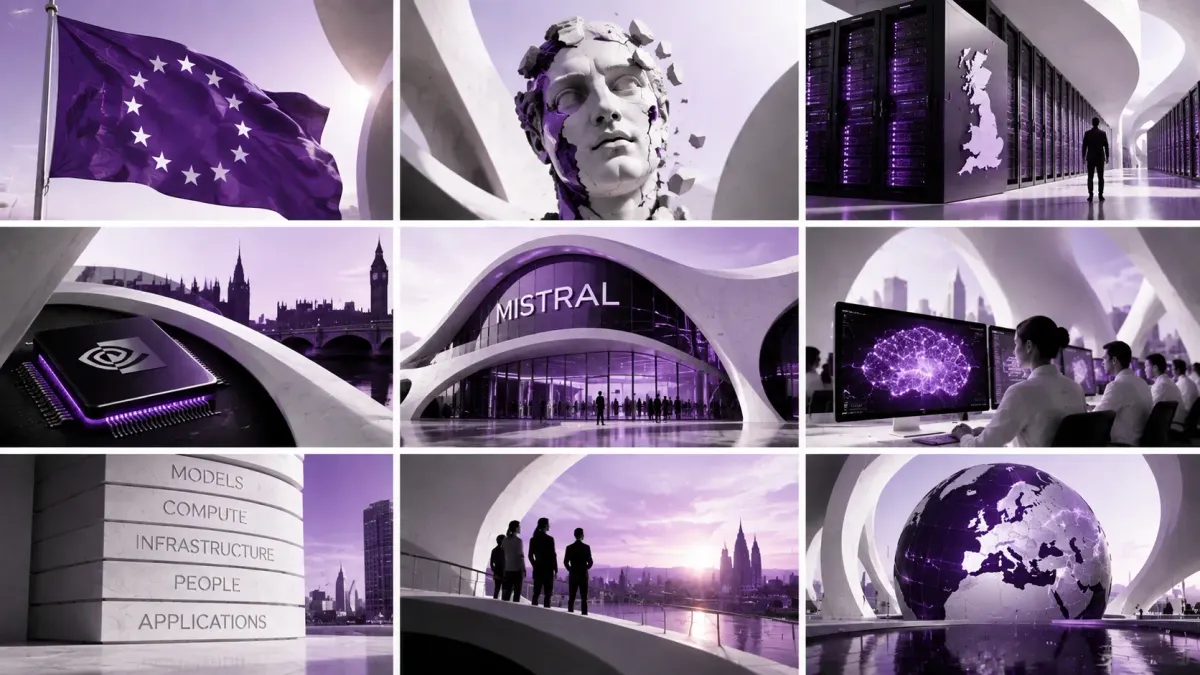
Mistral is trying to connect models, compute, infrastructure and deployment into one commercial system, giving Europe a much more serious test of whether sovereignty can become a working capability rather than a policy ambition.
AI sovereignty becomes meaningful when an organisation can keep an important AI capability running after someone else changes the terms. That was the uncomfortable lesson behind Emma, the harder lesson inside the UK's NVIDIA-backed buildout, and the talent problem exposed by Anthropic's recruitment of Andrej Karpathy. Mistral's new funding round puts enough private capital behind a European company to test those ideas together.
Mistral announced on September 8 that it had raised €3 billion at a post-money valuation above €21 billion. Samsung Electronics led the round, with the Scaleup Europe Fund, managed by EQT, and existing investor PSG Equity joining as co-leads. Mistral says the capital will expand frontier research, training compute, infrastructure, commercial growth and its international footprint.
Mistral is three years old, operates across 20 countries and says it supports more than 125 enterprises, including Airbus, ASML and HSBC. The company is now large enough to test whether the European sovereignty argument can survive contact with the cost of building frontier AI.
Meet Cantica, the Fin-Tech intelligence system for custom reports to strategise your next business move.
Emma showed what sovereignty cannot be
The Bright Minded's Emma analysis established the first part of the argument.
Italy's Emma-5 was suspended five days after launch following public testing that exposed basic reasoning and factual failures. The model had roughly 550 million parameters. Yet the underlying instinct behind the project was sound: a country that relies entirely on foreign AI systems has limited control over how those systems are built, deployed or withdrawn.
Mistral starts from a different position. Its product is already commercial, its models are already used by large organisations, and the company has spent the past three years moving from a model lab toward infrastructure and enterprise deployment.
That gives the sovereignty argument something Emma never had: customers with something to lose if the system fails.
The UK showed how many layers sovereignty requires
The UK's programme added another layer to the picture.
NVIDIA reported in June that 200,000 UK developers were enrolled in its developer programme, that its startup programme had grown, and that its Deep Learning Institute courses were embedded in government-funded apprenticeships. Up to £11 billion had also been committed to UK data-centre capacity.
The Bright Minded's UK analysis focused on what that combination actually means. A sovereign AI strategy needs people capable of operating the infrastructure, not just machines sitting inside a national border.
The same piece also exposed the unresolved dependency. The UK's most powerful computer runs on NVIDIA Grace Hopper chips. Training British developers to use the system creates domestic capability, but it does not give Britain control over the silicon underneath it.
Mistral cannot solve that problem either, even though it appears to have plans to do so.
Its sovereignty proposition operates at another layer. The company says its approach combines open-weight models, infrastructure and compute, with customers able to control where data stays, how models are customized, where computing happens and how production systems are audited.
That is a meaningful form of control. It is also a narrower definition of sovereignty than owning every component of the technology stack.
Mistral is trying to make the layers work together
This is where the €3 billion matters.
Mistral began in 2023 as a frontier-model company. Its founders, Arthur Mensch, Guillaume Lample and Timothée Lacroix, built the business around advanced AI models and an open approach. The company later expanded into products and enterprise deployment, and it is now investing heavily in the compute and infrastructure required to train and run those models.
The progression can be seen in the funding itself. In September 2025, Mistral raised €1.7 billion at a €11.7 billion post-money valuation in a round led by ASML, which invested €1.3 billion. NVIDIA and several major venture investors also participated.
One year later, the valuation has passed €21 billion and the new round is almost twice the size.
Mistral says the new capital will expand training compute and infrastructure alongside research and commercial operations. Its own description of the business is increasingly a full-stack one, covering models, compute, infrastructure and products.
That changes the nature of the European sovereignty experiment.
Emma asked whether Europe could produce its own model. The UK asked whether it could build infrastructure and talent around AI. Mistral is asking whether one European company can make those pieces commercially useful together.
The talent problem has not disappeared
There is still one layer that money cannot simply purchase: accumulated research expertise.
The Bright Minded's Karpathy analysis examined his move to Anthropic in May and the wider pattern behind it. Karpathy was hired to lead a pretraining team focused on using current AI systems to make the training of future systems faster. The article also documented a broader flow of senior technical people toward Anthropic.
That matters for sovereignty because frontier AI depends on concentrated expertise as much as it depends on computing capacity.
Mistral has serious research credentials of its own. The €3 billion gives it more room to recruit, train models and build infrastructure. It does not automatically give the company the research density accumulated by US labs that have been spending at a vastly larger scale.
The European question is therefore becoming harder, not easier. Capital can build capacity. Capacity can attract researchers. Researchers can build better models. Better models can attract customers. Only sustained execution can make that loop durable.
The investor list tells a second story about sovereignty
The composition of the round is particularly revealing. Samsung Electronics led it. ASML, which led Mistral's previous round, participated again. NVIDIA is also an existing investor. New investors include Advent, funds and accounts managed by BlackRock, and the Grand Duchy of Luxembourg.
That means Mistral is being financed by companies and institutions deeply connected to the global technology system it is trying to make less dependent on.
That is not a contradiction by itself. Mistral's sovereignty proposition is aimed primarily at the customer. A bank, government department or manufacturer can use an open-weight model, keep sensitive data within its own environment and control deployment without handing the entire AI relationship to one closed provider. Mistral itself defines sovereignty around data, models, compute and production control.
The shareholders do not determine whether that architecture works, but they do reveal the limits of the larger European ambition. Europe is building a company intended to give organisations more control over AI while that company remains embedded in a global semiconductor, hardware and capital ecosystem.
The UK example already showed that problem at the hardware layer. Mistral makes it visible at the corporate layer.
Sovereignty is becoming a procurement decision
That distinction matters outside government. A company choosing an AI system is also choosing how much control it wants over data, deployment, model customization and supplier dependence. Mistral's enterprise proposition turns those questions into something a procurement department can actually evaluate.
That matters in financial services and fintech, where data location, operational resilience and regulatory obligations can determine whether a model is usable at all.
Mistral says it now supports more than 125 enterprises and specifically names Airbus, ASML and HSBC among them. Those customers give the sovereignty argument a more demanding test than a national demonstration project does. A production system has to work, remain available and justify its cost.
Mistral has also been expanding European infrastructure before this round. In August, the company announced regional inference, open-model access and a plan to build up to 1 gigawatt of AI capacity by 2030. Its stated objective was to give enterprises and countries greater control over where AI runs and which models they use.
The €3 billion therefore arrives after the company has already started building the physical layer required for its argument.
The business has to prove that sovereignty can pay for itself
Mistral's valuation is now above €21 billion. Its previous round valued it at €11.7 billion. The company has attracted industrial investors, public capital and major venture firms. Yet the funding announcement itself discloses only a limited set of operating metrics: 20 countries and more than 125 enterprise customers.
Reuters reports that Mistral is projected to reach roughly $1 billion in annual recurring revenue by the end of 2026. That is the number that will eventually determine whether the sovereignty thesis becomes durable.
Governments can finance strategic infrastructure because they are buying resilience. Enterprises have a different test. They need performance, cost, reliability and a credible long-term supplier.
Mistral therefore has to demonstrate that sovereignty is not simply something European institutions want to have. It has to become something companies are willing to keep paying for.
Europe has moved past the symbolic stage
Mistral has models. It has enterprise customers. It has infrastructure ambitions. It has researchers. It has capital at a scale that makes the whole proposition testable.
That does not make Mistral sovereign in some absolute sense. No European company can currently manufacture every component required for frontier AI, and Mistral itself remains part of the global technology system.
It does give Europe something extremely useful: a company large enough to test whether control over AI can become an economically sustainable capability rather than an aspiration.
Editor's note
Every piece published on The Bright Minded goes through careful verification, but mistakes can happen. If you spot an error, have additional information, or want to flag anything, write to rosalia@thebrightminded.com