Matt Clifford Joins Anthropic: AI Policy Runs on Weaker Conflict Rules Than Finance
Matt Clifford joined Anthropic on 2 September 2026 while keeping the chair of UK research agency ARIA, a move no appointment rule required him to clear.

The Bright Recap
Matt Clifford wrote the UK AI Opportunities Action Plan and advised the Prime Minister on delivering it, without pay. On 2 September 2026 he joined Anthropic to run its relations with governments beyond North America, while keeping the chairmanship of ARIA, the agency that distributes British research money.
The UK business appointment rules cover ministers, senior Crown servants and special advisers. They do not cover unpaid advisers, and the committee that applied them closed in October 2025. A regulated financial firm, by contrast, must record every conflict of interest that could damage a client and report those situations to senior management annually.
To know more about this topic, read our related articles:
- UK sovereign AI and the Nvidia partnership
- The Fin-Tech intelligence system behind this publication
- What Emma got right about sovereignty
- How one government decision moved a frontier model
- Financial technology explained
Bright Answers
Did Matt Clifford break any rule by joining Anthropic?
No. The UK business appointment rules apply to former ministers, Crown servants at director general level and above, and special advisers at pay band four and equivalent. He advised the Prime Minister unpaid, which falls outside all three categories.
Why does this matter for financial firms?
The rules governing what supervised firms may deploy are drafted by people operating under fewer conflict obligations than the firms themselves. An authorised firm must document conflicts as a condition of its licence.
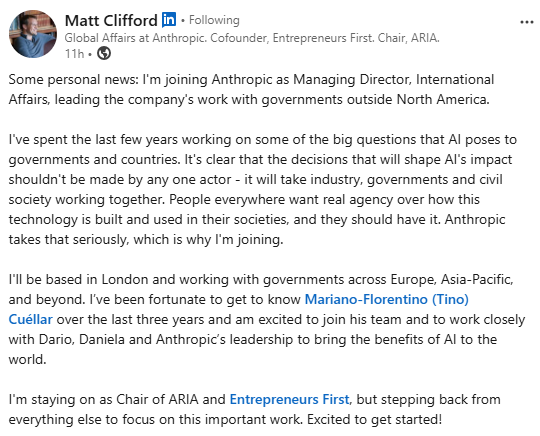
Matt Clifford announced on 2 September 2026 that he has joined Anthropic, handling the company's relations with governments beyond North America from an office in London. He is keeping the chairmanship of the Advanced Research and Invention Agency (ARIA), the public body that distributes British research money, which he has held since 2022.
Dame Chi Onwurah, who chairs the House of Commons Science, Innovation and Technology Committee, called the combination a clear conflict of interest and asked the artificial intelligence (AI) minister to set boundaries. No rule required him to ask anyone first.
The rules that did not apply
Clifford wrote the AI Opportunities Action Plan, the strategy the government published in January 2025 and adopted in full, which put domestic compute capacity and datacentre growth zones at the centre of the UK sovereign AI programme. He then advised the Prime Minister on delivering it, unpaid, and stepped down in mid-2025 after six months, citing personal reasons.
Britain does have rules for people leaving government for private jobs. They cover former ministers, Crown servants at director general level and above, and special advisers at pay band four and equivalent. The committee that applied them closed on 13 October 2025, and the work passed to the Independent Adviser on Ministerial Standards and the Civil Service Commission, which inherited those same three categories. An unpaid adviser to the Prime Minister belongs to none of them.
What everyone else has to file
Anyone working inside a regulated financial firm lives under a different regime entirely. The FCA Handbook requires firms to keep and regularly update a record of every situation where a conflict of interest could damage a client, to review the conflicts policy at least annually, and to put written reports on those situations in front of senior management at least once a year. The obligation sits on the firm and reaches every person inside it whose interests could bear on a client's. A financial technology company applying for authorisation has to show these arrangements exist before it takes a single customer.
The man who wrote the national strategy for the technology those firms are now deploying filed nothing, because there was nothing to file.
Why the gap exists
Britain built its standing in AI out of individuals rather than institutions. Clifford represented Rishi Sunak at the 2023 AI Safety Summit, helped create what became the AI Security Institute, chaired ARIA from its founding, and wrote the strategy the current government is still working through. One person did all four, and ARIA's own annual report for 2025-26 still lists him as chair.
Sovereignty in AI gets counted in datacentres, electricity and domestic compute, which is what his action plan proposed and what the Nvidia workforce partnership was built to serve. Those assets stay where they are put, which is the whole appeal, and it is where the sovereignty argument usually stops.
What Anthropic actually bought
Anthropic understands the value of the other kind, and it has reason to. The company has watched two of its own frontier models leave and return to the market one government decision at a time, which teaches you quickly that access to a country is settled by people in rooms rather than by anything sitting in a rack.
Clifford co-founded Entrepreneurs First, an investor in technical talent built on the proposition that the people are worth backing before the company exists. Anthropic has now applied that proposition to him. What it acquired is the part of British AI capability that no datacentre replaces.
Clifford says he is giving up his other commitments and retaining ARIA and Entrepreneurs First. His announcement lists the roles he is keeping and says nothing about how the ARIA conflict will be handled, and nothing obliges him to. Britain built its authority over artificial intelligence through people it never wrote any rules for.
Editor's note
Every piece published on The Bright Minded goes through careful verification, but mistakes can happen. If you spot an error, have additional information, or want to flag anything, write to rosalia@thebrightminded.com.