Lagarde's WEF Remarks Signal the Dangers of Non-Cooperation, and a Further Detachment From the US
Christine Lagarde's World Economic Forum remarks reassert the EU's role and read, between the lines, as a steady detachment from US politics.
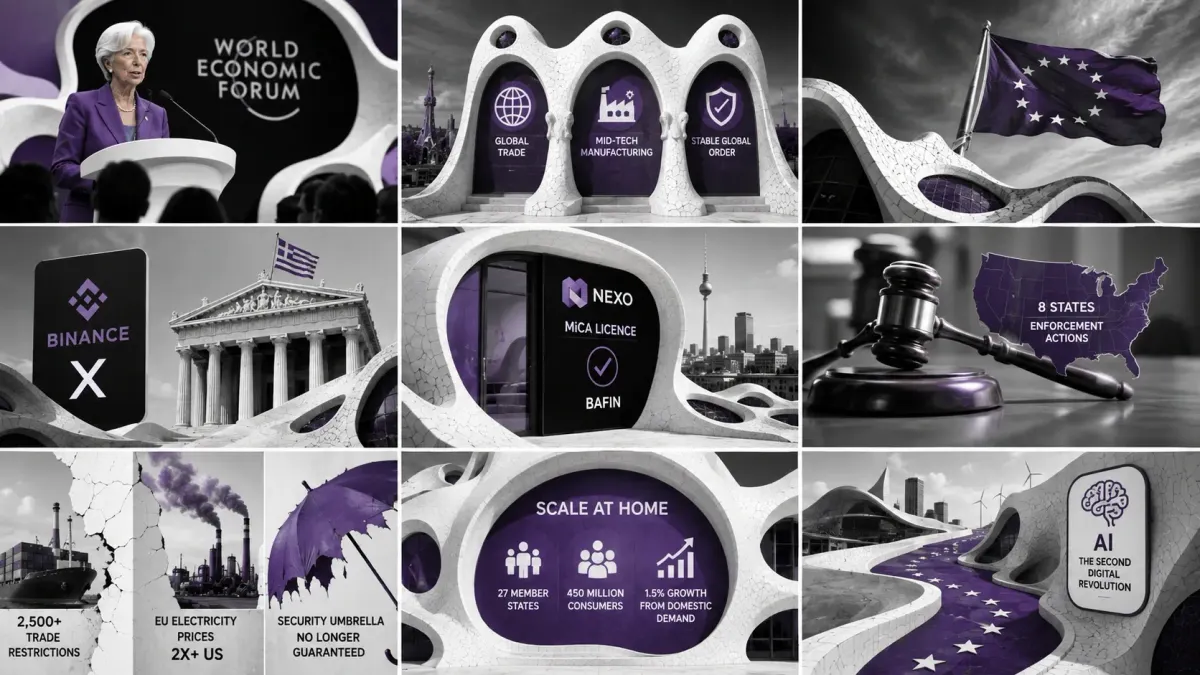
Christine Lagarde told the World Economic Forum that the three pillars of Europe's post-war growth are weakening at once, and read closely, the message is a Europe leaning away from Washington and towards itself.
Read more across The Bright Minded:
- The CLARITY Act - An ethical problem
- Binance's MiCA bid in Greece
- Nexo choosing a stricter regulator
- Financial technology, explained
What did Lagarde say at the World Economic Forum?
That Europe's three post-war growth pillars, open trade, mid-tech manufacturing on cheap energy, and a rules-based order under a US security umbrella, are eroding together, and that growth must now be rebuilt from inside the EU.
How does this connect to fintech and the US?
The Binance MiCA refusal in Greece and Nexo's approval under a stricter regulator show a bloc guarding its monetary sovereignty, and Lagarde's push to scale European firms and AI at home reads as steady distance from US dependence.
Christine Lagarde, President of the European Central Bank (ECB), addressed at the World Economic Forum (WEF) the three pillars on which the European Union founded its growth in the post-war era, and why they are changing now. Lagarde's remarks highlight the dangers of the current geopolitical situation, reasserting the role of the EU and, read between the lines, a progressive detachment from US politics.
A recent precedent: the Binance case
Lagarde's point of view was made evident in a recent event that hit the fintech world. The Bright Minded covered how Binance did not obtain a Markets in Crypto-Assets (MiCA) licence to continue operating in the EU. The case was controversial. Binance initially announced a possible licence through Greece, but later had to confirm the licence had not come.
According to the press, pressure from Lagarde was decisive in the Greek government's refusal of the licence. According to sources, Lagarde's intention was to avoid further influence from a foreign company that would have empowered US dollar (USD) pegged stablecoins.
On the other hand, a company like Nexo obtained the licence, and from the strictest regulator. Nexo's story is also closely tied to the US. In 2022 the company faced enforcement actions from eight US states, and after paying penalties it abandoned the US market.
Lagarde and the three pillars
Lagarde's words now carry a different weight, and seem to affirm the will to reinforce the EU, especially against the global effects of geopolitical strain driven by the Trump administration's decisions.
Those effects are closely correlated to the fintech and crypto world, not least because of practices that seem to disregard ethics. The three pillars of EU growth in the post-war era were the expansion of global trade, strength in mid-tech manufacturing, and a stable global order under the US umbrella.
Why Lagarde addressed the three pillars, and why they are under attack now
Global trade, the first, no longer expands on its own terms: more than 2,500 trade restrictions were introduced worldwide last year, and Europe, twice as open as the United States, sits more exposed than most.
Mid-tech manufacturing, the second, is squeezed from both ends, with China now competing directly in close to 40 percent of the sectors where Europe once held the advantage, up from around 25 percent in the early 2000s, while European electricity prices for heavy industry ran at more than double US levels. The cheap energy that underwrote the model, Russian gas included, is gone.
The third pillar is where her point sharpens. The rules-based order that let European supply chains deepen rested on an American security umbrella, and that umbrella is now something Europe can no longer assume. Dependencies that can be weaponised and deterrence that looks thinner push firms to stop organising investment around efficiency and start pricing in resilience. That is the moment a growth model built on someone else's guarantees stops paying.
Lagarde stopped short of calling for a break with Washington, and did not need to. The direction of the argument does the work: unreliable external supports point to one answer, which is to build the engine at home, and an engine built at home answers to Europe alone.
EU's answer: scale at home
The European Union already holds the largest integrated market among advanced economies, 27 member states and 450 million consumers, and last year its entire 1.5 percent of growth came from domestic demand. The task she set is to convert that size into scale, so a firm can start European and stay European instead of fragmenting across national rulebooks.
Two fault lines block that conversion. European scale-ups raise sums comparable to their San Francisco peers early on, then fall to roughly half as much by their tenth year, and around 12 percent leave the union altogether, most of them for the United States.
The same fragmentation that drains their capital slows the spread of financial technology across the bloc, which is where fintech stops being a sector and becomes a test of whether Europe can keep its own builders. The sharpest version of that test is artificial intelligence (AI). Lagarde called it the second digital revolution and was blunt about the first, which Europe largely watched from the sidelines while the gains accrued elsewhere. Euro area firms expect to put around 9 percent of their investment into AI this year, and the question is whether that money compounds across a single market or dissipates across 27 of them.
A Europe that builds its own engine is a Europe that needs Washington a little less each year, and Lagarde chose the World Economic Forum to say so without saying it.
Editor's note
Every piece published on The Bright Minded goes through careful verification, but mistakes can happen. If you spot an error, have additional information, or want to flag anything, write to rosalia@thebrightminded.com.