
Great British Summer Savings: The VAT Cut Only Reaches Families If Businesses Choose to Pass It On
The UK's Great British Summer Savings website helps families find businesses passing on the VAT cut. Whether the saving reaches you depends on each one choosing to.
The Bright Recap
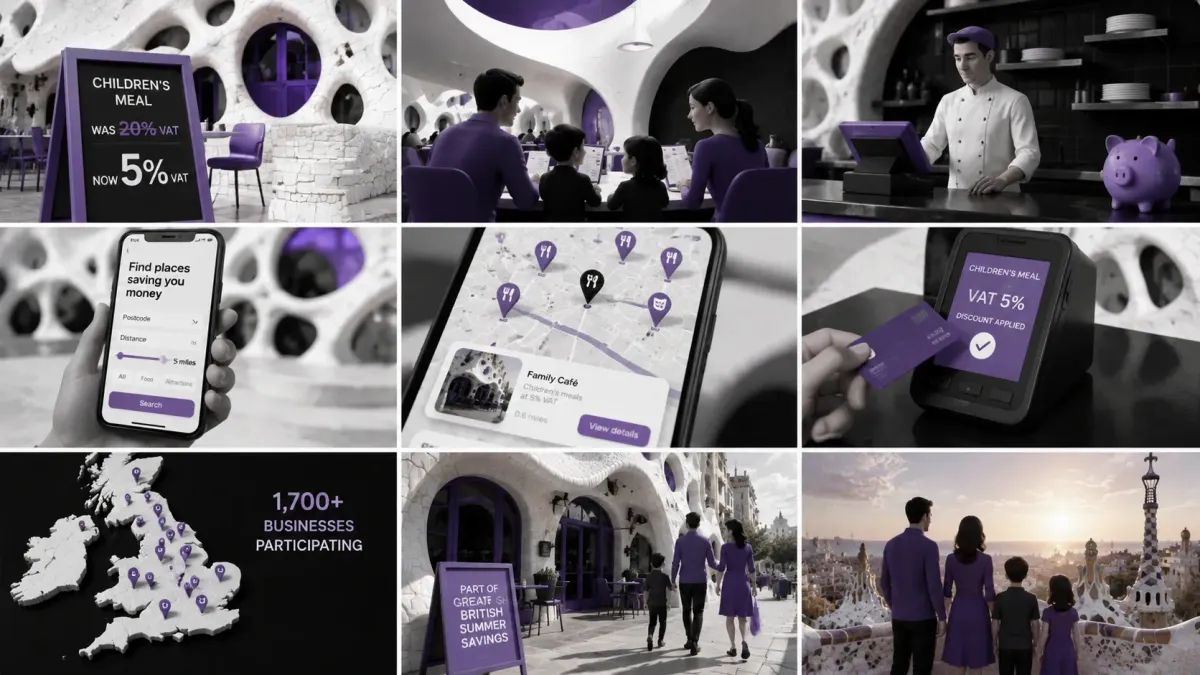
HM Treasury launched the Great British Summer Savings website on 15 July 2026. Families enter a postcode, set how far they will travel, and see nearby businesses passing on the Chancellor's temporary VAT cut from 20% to 5% on children's meals and family attractions, with the discount applied automatically at booking.
To know more about this topic, read our related articles:
- Tools that change how we spend
- When the saving reaches the right people
- Financial technology explained
Bright Answers
How does the Great British Summer Savings website work?
You enter your postcode, set a travel distance, and optionally filter by type of food or attraction. The site lists participating businesses near you and shows them on a map. You book or buy as normal, and the discount comes off automatically.
Is every family activity cheaper this summer?
No. The VAT cut applies only to eligible activities, mainly children's restaurant meals and family attraction tickets, and only where a business chooses to join the scheme and pass the saving on. The website shows which local businesses have done so.
A tax cut on a product is a hope until a business decides to honour it. When the Chancellor lowers Value Added Tax (VAT) on a children's meal from 20% to 5%, nothing forces the restaurant to drop its price, because the restaurant can keep its menu unchanged and pocket the difference as margin. That single decision, taken separately by thousands of firms, determines whether a family sees any of the money. On 15 July 2026, HM Treasury launched a website built around exactly that decision.
This story was Elevated by Cantica's Purgatorio.
Cantica is the Fin-Tech intelligence system behind The Bright Minded.
What the tool genuinely does for a family
The honest good news comes first, because it is real. A parent trying to plan a cheaper day out has never faced only a price problem. The harder task is finding which nearby places are actually offering less, which means time on the phone, tabs open across a dozen sites, and no easy way to compare. The Great British Summer Savings website collapses that into one action. A family enters a postcode, sets how far they are willing to travel, filters by food or attraction if they want to, and sees a list and a map of participating businesses close to home.
The discount then applies on its own. Someone books a table or buys a ticket the way they always would, and the reduced price comes off at the point of payment with no code to remember and no form to complete. This helps the family in Yeovil or Scarborough exactly as much as the one in central London. Removing search cost is a modest thing to do for people, and it is a genuine thing, and it is the kind of quiet usefulness that gets overlooked because it does not sound dramatic.
Why the saving is never automatic
The mechanics behind the cut explain why the website has to exist at all. VAT is a tax the business collects and hands to the state, so a reduction lands first on the business, and passing it to the customer is a choice. Economists call the share that reaches the customer the pass-through rate, and it is rarely the full amount.
Two features of this scheme make full pass-through harder. It is temporary, running only from 25 June to 1 September 2026, and a business weighing whether to reprint menus and reprogram tills for a ten-week window may decide the effort is not worth it. It is also selective, covering children's meals and family attraction admissions rather than a whole sector, so a restaurant has to separate eligible items from everything else on the same bill. The easier path for any single firm is to leave prices where they are, which is why a government that wants the money to reach families cannot simply announce the cut and step back.
The website is enforcement the government could not otherwise reach
A state has almost no direct lever to make a private business lower a price. It can legislate the tax rate, and there its power ends. What the Treasury has done instead is turn participation into something a customer can see, and absence from the list into something a customer notices.
Over 1,700 businesses currently appear on the site, and the Treasury says it is contacting others daily to bring them in. Being on the list becomes a marketing advantage, since a searching family finds the participating restaurant and skips the one next door that kept its prices flat. This is the same competitive pressure that appears whenever a saving is steered toward the people it was meant for, and here it is close to the only mechanism available. The government cannot compel the price drop, so it has built a tool that makes passing the saving on the commercially smarter move.
Why this sits on the fintech axis
A postcode, a distance dial and an automatic discount at checkout form a piece of financial technology that changes how a family relates to its own spending, much as everyday money tools have started to shift small financial decisions for people who never went looking for them. The state is running discovery and matching for a public policy the way a private platform runs it for profit, which is a role governments have rarely played directly.
That framing also marks the limit. A discovery layer is powerful for the person who has a day out somewhere in the budget and needs help finding the cheapest version of it. For a family with nothing spare after the essentials, a better search tool changes nothing, because the barrier was never locating the deal.
The website lightens the work of finding a saving, and whether a saving exists at all still rests with every business that decides, one till at a time, to let the customer keep the difference.
Editor's note
Every piece published on The Bright Minded goes through careful verification, but mistakes can happen. If you spot an error, have additional information, or want to flag anything, write to rosalia@thebrightminded.com.