Compliance Embedding and Rail Capture: Fintech Found Two Ways to Make Itself Irreplaceable
Compliance embedding and rail capture are the two strategies fintech firms are using to become operationally irreplaceable to the institutions they partner with.
"The institution needs the fintech firm's infrastructure more than the fintech firm needs the institution's customers".
Fintech firms have found two ways to become operationally irreplaceable to the institutions they partner with: compliance embedding and rail capture. Both were confirmed in practice today.
Compliance embedding
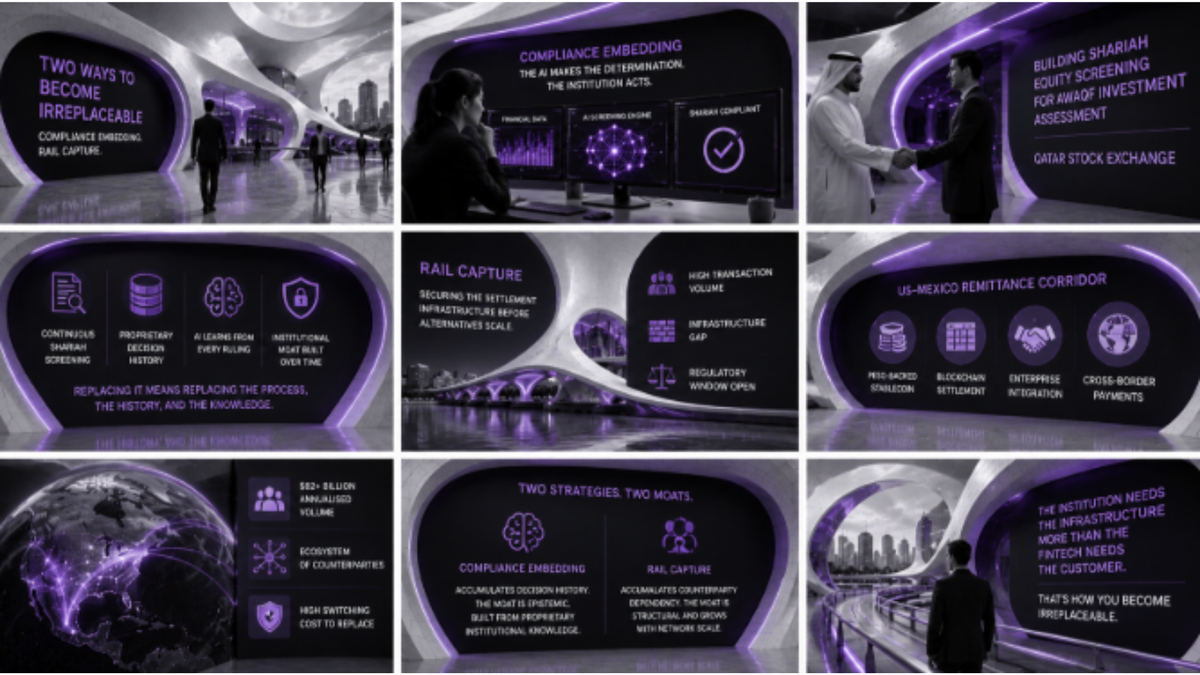
Compliance embedding positions a fintech firm inside an institution's decision-making process rather than alongside it. The technology produces the determination the institution acts on, not an output the institution evaluates independently. Replacing it means replacing an operational function, the accumulated decision history, and the proprietary interpretation of sector-specific rules the system has built on the institution's own data.
Shariah equity screening requires continuous analysis of financial characteristics mapped against jurisprudential interpretation that evolves with scholarly consensus. An AI system embedded in that process accumulates every determination it makes as training data no external competitor can replicate without the same institutional relationships and the same volume of proprietary decisions. Wahed's signed agreement with Qatar's General Directorate of Endowments to build this kind of platform for Awqaf's internal investment assessment across the Qatar Stock Exchange, confirmed today, is compliance embedding in practice.
The institution that adopts it has not purchased a fintech product. It has reorganised its investment process around fintech infrastructure.
Rail capture
Rail capture secures a position in the settlement infrastructure of a specific corridor before competing architecture can establish equivalent footing. Three conditions make a corridor viable: high transaction volume, structurally inadequate existing infrastructure, and a regulatory window that has not yet closed around a dominant standard.
The US-Mexico remittance corridor satisfies all three. Ripple and Bitso confirmed today the integration of MXNB, Bitso's regulated peso-backed stablecoin, into Ripple's XRP Ledger Permissioned Decentralised Exchange alongside RLUSD for enterprise cross-border settlement across that corridor. Bitso Business processes over $82 billion in annualised transaction volume. Once enterprise counterparties build treasury operations around a shared blockchain settlement layer, displacing it requires moving an entire ecosystem of counterparties simultaneously, a coordination cost that functions as a structural barrier regardless of what any individual firm would prefer.
What each strategy accumulates
Compliance embedding accumulates decision history. Every determination the AI produces becomes proprietary data that deepens the institution's dependency on the system that generated it. The moat is epistemic, built from the institution's own rules interpreted at scale over time.
Rail capture accumulates counterparty dependency. Every enterprise firm that integrates the settlement layer raises the switching cost for every other firm in the corridor, and every new counterparty that joins makes the position harder to dislodge.
Both strategies represent a clean break from the distribution logic that defined fintech partnerships through the previous decade, where the fintech firm needed the institution's reach. AI reaching individuals through access rather than architecture still operates on that logic.
Compliance embedding and rail capture operate on a different assumption: that the institution needs the fintech firm's infrastructure more than the fintech firm needs the institution's customers. The firms that have understood this are asking which layer of their partner's operation they can make structurally their own.
Editor's note
Every piece published on The Bright Minded goes through careful verification, but mistakes can happen. If you spot an error, have additional information, or want to flag anything, write to rosalia@thebrightminded.com.