
Cloudflare Layoffs 2026: Why a Company Growing at 34% Still Cut 20% of Its Workforce
Cloudflare cut 1,100 jobs while posting 34% revenue growth in Q1 2026. What the combination reveals about AI productivity and workforce restructuring.

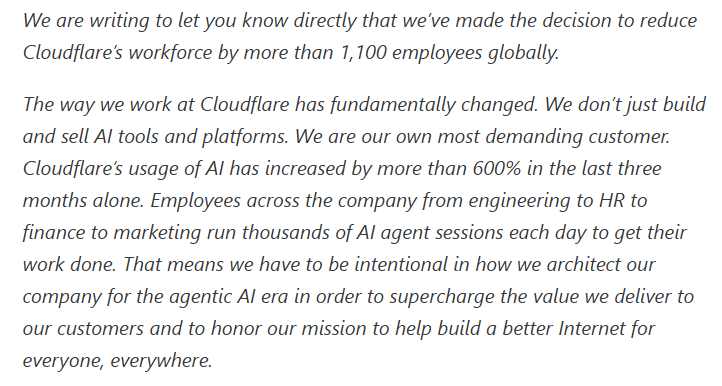
Cloudflare's founders published a letter to every employee on May 7, 2026, announcing the elimination of 1,100 jobs, 20% of its 5,156-person workforce. The same day, the company reported first-quarter revenue of $639.8 million, up 34% year-on-year, with earnings per share above analyst expectations. Internal AI agent use across the company had grown by more than 600% in three months. Cloudflare concluded it was structured for a company that no longer existed.
What changed inside the company
The founders described the cuts as a reorganization around an agentic AI-first operating model, not a response to underperformance or a cost reduction exercise. Employees across every function, from engineering to finance to marketing, had been running thousands of AI agent sessions each day to complete their work. The company's argument was that this changed not just the output per person but the number of people the work required at all. Cloudflare had been building and selling AI tools to its customers while simultaneously becoming, by its own account, the most demanding internal user of those same tools.
The terms of departure
According to its SEC filing, Cloudflare expects to incur between $140 million and $150 million in total restructuring costs, the bulk comprising cash severance payments covering notice periods and benefits, with the plan substantially complete by the end of Q3 2026.
For US-based employees, healthcare coverage extends through the end of 2026, and equity vesting for departing staff continues through August 15, including for those who had not yet reached their one-year cliff. The founders stated their intention to act only once, describing incremental cuts as a source of prolonged uncertainty that stalls both people and operations.
Why investors were not convinced
Cloudflare shares fell 24% on May 8, 2026. Second-quarter revenue guidance came in slightly below Wall Street expectations, and analysts at Jefferies flagged that large-scale workforce reductions could weigh on near-term growth. The concern is not unreasonable: a company eliminating a fifth of its people while promising to accelerate carries real execution risk. But the investor reaction addresses the short-term arithmetic and leaves the underlying question untouched.
What the announcement actually measures
The Cloudflare decision sits alongside a pattern building across the sector. Coinbase's earlier restructuring raised similar questions about what AI-driven reorganization actually looks like from the inside. What distinguishes the Cloudflare case is the directness of the claim: a company in sound financial health, in a fintech-adjacent sector posting strong growth, chose to cut 20% of its workforce because the work had genuinely changed. AI's effect on hiring has not been linear: productivity gains have simultaneously created new demand for certain engineering roles even as they reduce others, a pattern that makes the net picture harder to read.
Editor's note
Every piece published on The Bright Minded goes through careful verification, but mistakes can happen. If you spot an error, have additional information, or want to flag anything, write to rosalia@thebrightminded.com.