
CFTC Retires Nine Years of No-Action Letters on Event Contract Reporting
The CFTC proposed new reporting rules for event contracts. The filing ends nine years of patchwork letters and reveals what forced the rewrite.
The Bright Recap
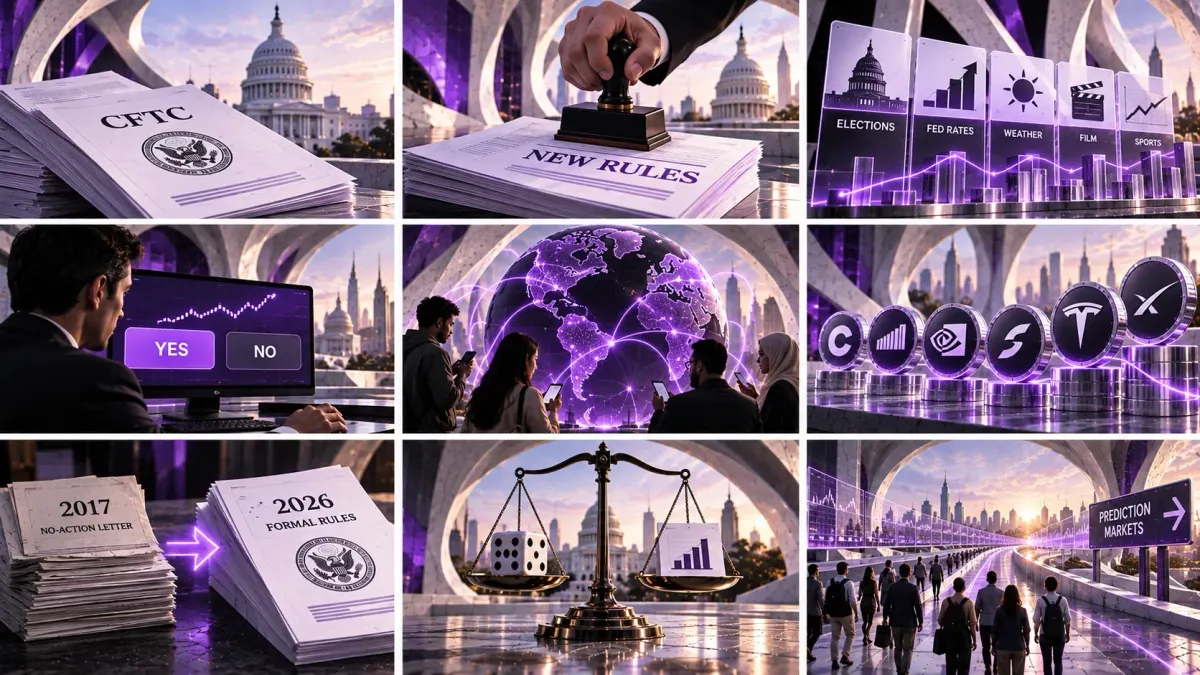
On 25 June 2026, the CFTC proposed amendments to Parts 15, 16, and 17 of its regulations, retiring a reporting framework for certain event contracts that had run on informal staff no-action letters since 2017. Chairman Michael Selig said the agency will no longer regulate market participants through what he called a patchwork of no-action letters serving as band-aids for unworkable regulations.
The filing followed, by two weeks, the most comprehensive prediction-market rulebook the CFTC has ever proposed, one that exists only because the agency spent over a decade losing the same legal argument in court against Nadex, ErisX, and Kalshi. Annual event contract listings rose from an average of roughly five before 2021 to approximately 1,600 in 2025, and trading volume across CFTC-registered prediction markets passed $25 billion that year. Both proposals are the same admission made twice: a market the regulator once treated as a curiosity grew too fast for the patchwork meant to contain it.
To know more about this topic, read our related articles:
Bright Answers
What did the CFTC change about event contract reporting on 25 June 2026?
The Commission proposed moving reporting for certain fully collateralised event contracts into Parts 15 through 18 of its regulations, the same framework used for ordinary futures contracts, replacing rules built for swaps under Parts 38, 39, 43, and 45 and ending nine years of informal no-action letters.
Why did the CFTC need a no-action letter for event contracts since 2017?
Event contracts technically triggered swap data reporting rules even though they traded and settled more like simple futures, so CFTC staff issued informal letters easing those obligations rather than rewriting the underlying regulation, an arrangement renewed repeatedly until the 25 June proposal made it permanent.
CFTC event contract reporting rules changed on 25 June 2026, when the Commodity Futures Trading Commission proposed amendments to Parts 15, 16, and 17 of its own regulations, retiring a reporting framework that had run on informal staff letters since 2017.
Certain fully collateralised event contracts, the kind that pay out a fixed amount if a named outcome occurs and nothing if it does not, will now be reported the way an ordinary futures contract is reported, rather than under the more complex rules built for swaps. Chairman Michael Selig's own words frame the size of the problem this fixes: "the CFTC will no longer regulate market participants through a patchwork of no-action letters, which serve as band-aids for unworkable regulations."
A no-action letter is not a rule. The CFTC has been running large parts of the prediction-market industry on promises since 2017, and the 25 June filing is the second time in two weeks the agency has had to admit, in public, that the temporary fix has outlived its usefulness.
A market the rulebook was never built for
To see why a reporting fix matters, it helps to see what it is reporting on. Event contracts let someone take a position on whether something will happen, an election result, a Federal Reserve decision, a temperature threshold, a film's opening weekend. The CFTC's own account of the market's growth, set out in its 10 June rulemaking, is the clearest evidence of how fast this happened. From 2006 through 2020, exchanges listed an average of roughly five new event contracts a year. That number rose to 131 in 2021, and stayed at a broadly similar level through 2024. By 2025, exchanges certified approximately 1,600 new event contracts, and total trading volume across CFTC-registered prediction markets passed $25 billion that year.
Set against the $31 trillion in notional value the CFTC oversees across the entire futures market, $25 billion is still a small fraction. But the speed of the climb is what broke the old approach. A regulator built around reviewing a handful of new contract types a year cannot run an individualised 90-day public-interest review, its standard tool, on 1,600 new listings without the tool collapsing under its own weight. Reporting rules face the identical problem from a different angle: a framework built for a handful of swap-style products cannot scale cleanly to thousands of contracts that behave more like simple futures than like swaps, which is exactly why CFTC staff had been patching the gap with informal letters rather than rewriting the actual rule.
The patch the CFTC kept renewing instead of replacing
The no-action letters this proposal retires were never meant to be permanent. CFTC staff issued the first relevant relief for fully collateralised event contracts in 2017, allowing certain markets to report under simpler futures-style rules rather than the swap data regime that technically applied to them. That arrangement should have been temporary, a bridge while the Commission figured out a permanent framework. Instead, staff kept renewing it. The most recent extension, Letter 26-14, arrived in May 2026, nine years after the first one.
Nine years of renewed temporary relief is not a regulatory choice so much as a regulatory habit, and the habit has a cost. A market operating on a no-action letter knows the rule could, in principle, be enforced at any time, because the letter is only a promise from staff, not a change to the regulation itself. That uncertainty sits quietly underneath every exchange, clearing member, and broker that built compliance systems around the assumption the letter would simply be renewed again. The 25 June proposal is the Commission finally agreeing that nine years of renewal is long enough to know the exception is not an exception. It is the actual shape the market takes, and the rulebook needs to say so directly.
The fight that forced the bigger rule two weeks earlier
The reporting fix did not arrive in isolation. It followed, by two weeks, the most consequential prediction-market rulemaking the CFTC has ever attempted, one that exists only because the Commission spent over a decade losing the same argument in court.
The CFTC's main lever for blocking a prediction-market contract is a provision Congress added in 2010 letting the agency stop any event contract that "involves" gaming, terrorism, war, assassination, or other unlawful activity. In 2012, the Commission used that lever against Nadex's election-outcome contracts, reasoning that trading itself amounted to gaming. In 2021, ErisX withdrew its NFL-outcome contracts one day before its own review period was due to end, after a commissioner later revealed staff had already drafted an order against them. In 2023, the Commission tried the same underlying argument against Kalshi's congressional-control contracts, again treating the act of trading as the gambling itself.
A federal court disagreed, ruling in September 2024 that Kalshi's contracts involved neither gaming nor unlawful activity. The Commission's own 10 June filing now concedes the court read the statute correctly. What matters under the law, the Commission writes, is not whether placing a trade resembles a bet, but whether the event being traded on, an election, a war, a killing, is itself one of the activities Congress listed. An election is not gaming merely because someone takes a position on it. A war is war, however someone bets on it. That distinction is the one the Commission spent three consecutive enforcement attempts getting backwards.
Two filings, one admission
Read together, the 10 June and 25 June proposals are the same admission made twice, once about what the CFTC is allowed to prohibit, and once about how it tracks what it allows. For years, the agency tried to control this market's growth by stretching a single word, gaming, far enough to cover whatever it wanted to stop, and by patching its reporting rules with promises not to enforce them. Both approaches worked only as long as the market stayed small enough not to test them.
It did not stay small. Annual contract listings went from an average of roughly five before 2021 to approximately 1,600 in 2025 alone. The Commission's legal theory broke first, in a courtroom, in 2024. Its reporting infrastructure broke second, by its own admission, in 2026. Selig's description of the old approach as a patchwork of band-aids is the most precise word a regulator has used yet for nine years spent avoiding the rule it is only now willing to write.
What it means for the market this actually governs
For anyone watching fintech build genuinely new financial infrastructure rather than rehouse old products, the more durable lesson sits underneath the Selig quote rather than inside it. Markets that grow exponentially do not wait for regulators to finish deciding what they are. Prediction markets spent the better part of two decades as a curiosity contained by a handful of academic exchanges and one or two legal disputes a year. The moment that changed, the regulator's entire apparatus, built for steady, incremental growth, had to be rebuilt twice in a single month just to catch up to where the market already was.
The CFTC did not choose to write a comprehensive public-interest framework on 10 June and a modern reporting regime on 25 June because either was due on a schedule. It wrote them because the alternative, one more year of letters that promise not to enforce a rule everyone already knows does not fit, had stopped being a credible option. The clearest measure of how fast a market has outgrown its regulator is not the size of the market. It is the number of patches the regulator has to publicly admit it was using to avoid building the real thing.
Editor's note
Every piece published on The Bright Minded goes through careful verification, but mistakes can happen. If you spot an error, have additional information, or want to flag anything, write to rosalia@thebrightminded.com.