
Prediction Markets and Insider Trading: The Classification Fight That Determines Who Gets to Play
A US soldier made $400,000 betting on a classified military operation. Here is what that reveals about a $20 billion market still fighting over what it is.
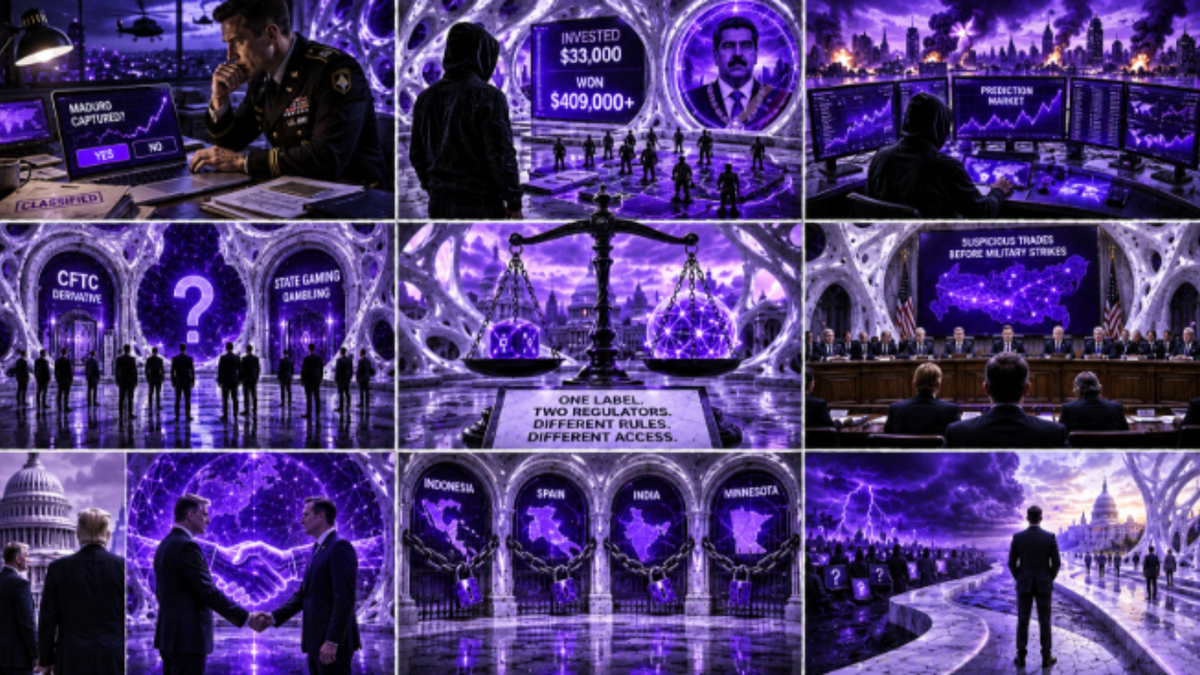
In April, a US Army Master Sergeant named Gannon Van Dyke was federally indicted for using classified military intelligence to place bets on a prediction market. The operation was the capture of Venezuelan President Nicolás Maduro. Van Dyke knew the outcome before it happened, invested $33,000 in contracts predicting it, and according to the House Oversight Committee, generated more than $409,000 when it did. He was not an anomaly.
What a prediction market is and why the label matters
A prediction market is a platform where people buy and sell contracts tied to the outcome of future events. Each contract pays out if the event occurs and expires worthless if it does not. The price at any moment reflects what the pool of traders collectively believes about the probability of that outcome. The mechanism expanded from academic experiments into a market handling an estimated $20 billion in monthly trading volume, driven by the idea that prices built from many individual bets will, on aggregate, be more accurate than any single forecast.
The legal classification of that mechanism in the United States is unresolved, and the answer determines nearly everything. The Commodity Futures Trading Commission, the federal agency that regulates derivatives, considers prediction market contracts financial instruments under its exclusive authority.
State gaming regulators consider them gambling products, subject to the same rules as casinos and sportsbooks. Both positions carry different access restrictions, different consumer protections, and different consequences for who is allowed to participate. Both sides have been filing lawsuits to establish which one is right.
The insider trading problem
The Van Dyke indictment is the sharpest illustration of a pattern that had been building for months. A New York Times investigation identified more than 80 Polymarket users whose trades showed suspicious patterns, among them bets placed in the hours before US and Israeli military strikes against Iran that had not been publicly disclosed.
Nine accounts earned a combined $2.4 million on Iran-related contracts. One trader, operating across three separate US and Israeli military operations between October 2024 and February 2026, placed bets hours before each strike and achieved a 93% success rate, generating close to $1 million in profits.
In a separate case documented by Senator Warner's office, prediction market users bet that a White House press secretary's briefing would end within 65 minutes and collected when it ended 30 seconds before that mark. The mechanism that makes prediction markets valuable is precisely what makes these cases possible: their prices aggregate what people believe, and when some of those people have classified information or advance knowledge of government decisions, the market cannot distinguish their positions from those of any other trader.
House Oversight Chair James Comer, who launched a congressional investigation on May 22 requesting documents from both Kalshi and Polymarket by June 5, described the current environment as the Wild West and said he may pursue legislation banning members of Congress, administration officials, and federal employees from participating in prediction markets entirely.
In April, the Senate had also passed a unanimous bipartisan measure prohibiting senators and their staff from placing trades on prediction market platforms.
The federal position and who benefits from it
On May 26, President Trump posted on Truth Social that it was critically important for the Commodity Futures Trading Commission (CFTC) to maintain exclusive authority over prediction markets, attacking four state officials by name for attempting to regulate them at the state level. His administration has directed the CFTC to open regulatory doors for financial technology broadly.
The CFTC, under Trump's appointed chair Michael Selig, has filed lawsuits against at least six states, including Minnesota, which signed an outright ban with criminal penalties into law, with the Trump administration filing suit the following day to block it before it takes effect in August. Donald Trump Jr. serves as a paid strategic adviser to Kalshi and sits on Polymarket's advisory board, having invested a double-digit-million-dollar sum in the industry through his venture firm.
The regulatory pressure is not confined to the United States. Indonesia, Spain, and India each banned prediction markets from operating within their borders in the week preceding Trump's post. The CFTC's proposed regulatory framework for prediction market contracts was under White House review as of May 27. Kalshi and Polymarket have both moved to tighten identity verification and trade surveillance in response to congressional scrutiny.
What the market reveals
Prediction markets were built on the premise that prices reflect what people know. The Van Dyke indictment and the Iran trades suggest they also reflect what some people know privately, through classified access the market has no mechanism to screen for.
The classification debate between the CFTC and state regulators has not addressed this, and neither has the broader question of whether the people writing the rules for a new financial instrument should also be allowed to profit from it, the same question stalling the CLARITY Act in Congress. Prediction markets do not just predict outcomes. They reveal who knew what, and when.
Editor's note
Every piece published on The Bright Minded goes through careful verification, but mistakes can happen. If you spot an error, have additional information, or want to flag anything, write to rosalia@thebrightminded.com.