Bitpanda's MiCA Fine Turns on the Sequence of a Crypto Launch
The Bitpanda MiCA fine, €70,000 from Austria's FMA, was for marketing a token before its white paper was published and filing it late.
The Bright Recap
The Bitpanda MiCA fine, €70,000 from Austria's Financial Market Authority (FMA), is the first penalty published under the Markets in Crypto-Assets Regulation (MiCA). It rests on the sequence of a token launch, and the FMA confirmed that no customer funds were affected.
To know more about this topic, read our related articles:
- How the FCA polices crypto promotion
- Check whether your exchange survives 1 July
- Financial technology explained
Bright Answers
Why was Bitpanda fined under MiCA?
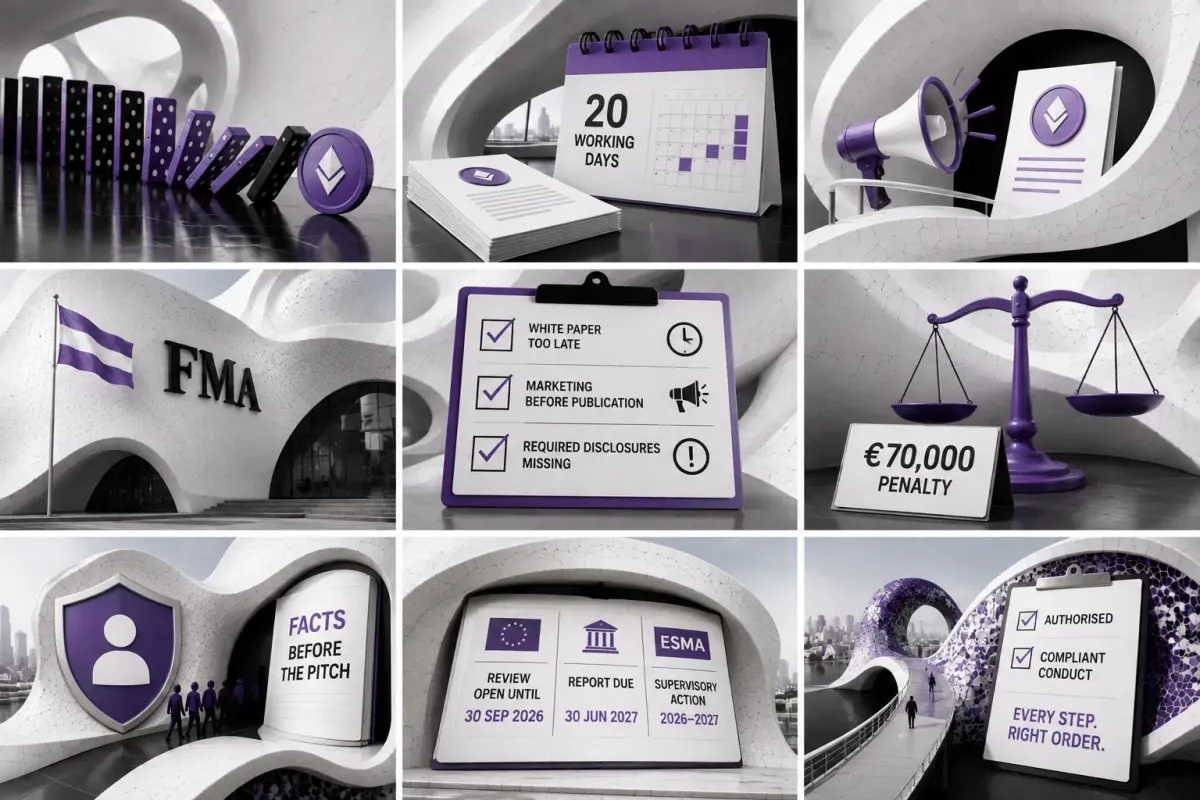
The Financial Market Authority found that Bitpanda distributed a marketing communication before publishing the required crypto-asset white paper, and that the white paper reached the regulator fewer than 20 working days before publication, breaching Articles 7 and 8 of MiCA.
Did anyone lose money in the Bitpanda MiCA case?
No. The regulator stated the case concerned the timing and formal requirements around a white paper and its marketing, and that customer funds and platform security were not affected.
Every step in a crypto launch can be lawful on its own and still produce a penalty when the steps happen in the wrong order. The Bitpanda MiCA fine, €70,000 imposed by Austria's Financial Market Authority (FMA), is the first penalty the regulator has published under the European Union's Markets in Crypto-Assets Regulation (MiCA), and it rests entirely on that principle. Bitpanda wrote a crypto-asset white paper, published it, and marketed the token. The timing that connected those acts is what the FMA sanctioned.
A rule about order
The Markets in Crypto-Assets Regulation sets a fixed order for bringing a token to the public. A crypto-asset white paper, the mandatory document describing the token and its risks, must reach the national regulator at least 20 working days before it is published. A marketing communication for that token may go out only once the white paper itself is public. These timing rules are now part of how financial technology is supervised across the European Union, and they carry penalties when the order slips.
What the FMA cited
The FMA notice sets out the findings against Bitpanda GmbH. The company submitted a white paper to the regulator fewer than 20 working days before publishing it, then distributed a marketing communication before that white paper was public. A further marketing message left out the required notice that no authority had reviewed or approved the document and that the offeror alone is responsible for it, along with a contact telephone number and email address.
The articles behind the penalty
The penalty draws on Articles 7 and 8 of the regulation, which govern marketing communications and the notification of white papers. Article 8 fixes the 20-working-day notice period, and Article 7 requires that marketing follow publication and carry specific disclosures. None of the findings concern fraud, custody, or lost customer money. The FMA concluded the case through an accelerated procedure, and the decision is final.
The reason the order exists
The order exists to protect the people being marketed to. A buyer should be able to read the disclosure before meeting the promotion, which is the established rule in public securities offerings, where a prospectus must be available before a sale can be solicited. Crypto promotion now runs on that same clock. Regulators beyond the bloc apply the same logic to unauthorised crypto promotions.
Enforcement as the rulebook reopens
The penalty lands while the rulebook it enforces is under active review. The European Commission's review of MiCA is open until 30 September 2026, feeding a report to the European Parliament and Council under Articles 140 and 142, due by 30 June 2027. The European Securities and Markets Authority (ESMA) launched its first common supervisory action under MiCA on 8 July 2026, examining how crypto-asset service providers protect client assets and manage operational risk into 2027. Austria enforced the current text while that review remains open.
From licence to conduct
Bitpanda holds MiCA authorisation, granted by Germany's Federal Financial Supervisory Authority in January 2025 and by the FMA in April 2025. The sanction concerns conduct inside that authorisation. The rules that govern how each token is offered and promoted apply on top of it. The transition that ended on the 1 July deadline moved firms into this phase, where holding a licence is the condition that invites ongoing scrutiny.
Crypto marketing in Europe now answers to one of the oldest rules in regulated finance, that the facts must reach people before the pitch does, and the first firm held to it in public had every document in hand and released them out of turn.
Editor's note
Every piece published on The Bright Minded goes through careful verification, but mistakes can happen. If you spot an error, have additional information, or want to flag anything, write to rosalia@thebrightminded.com.