
Binance Has No MiCA Application in France, Only a Conversation That Might Save It
Binance has not filed a MiCA application in France. According to The Big Whale, talks with the AMF are its only path left after Greece collapsed.
The Bright Recap
Binance has not filed a Markets in Crypto-Assets (MiCA) application in France. Talks are underway with the Autorité des Marchés Financiers (AMF), France's market regulator, and Binance France SAS already holds a Digital Asset Service Provider (DASP) registration in France that predates MiCA, granted in May 2022.
Binance's Greek application was reportedly complete and compliant right up until it fell apart in mid-June, a shift several sources trace to political pressure from the European Central Bank rather than any flaw in the filing itself. Neither the ECB nor the Greek government has confirmed this.
To know more about this topic, read our related articles:
- The Greek attempt
- Binance's Italian wind-down
- Nexo's regulator choice
- Bybit's campaign
- Financial technology explained
Bright Answers
Has Binance filed a MiCA application in France?
No formal application has reached French regulators. Talks with the AMF remain informal, according to The Big Whale.
Why did Binance's Greek MiCA application collapse?
Sources cited by The Big Whale describe the Greek file as complete and compliant, attributing its collapse to political pressure from the European Central Bank rather than any deficiency in the filing.
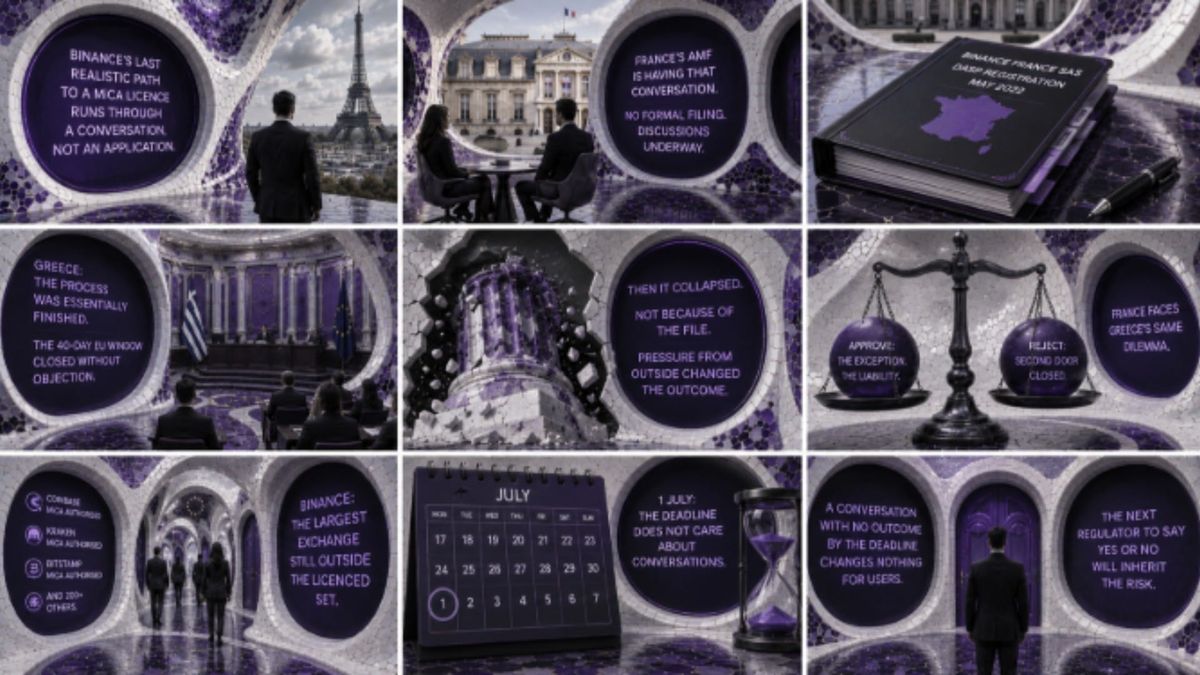
Binance's last realistic path to a Markets in Crypto-Assets (MiCA) licence in the European Union currently runs through an informal conversation, not a filed application. France's market regulator is the one having that conversation, occupying the same role Greece played for the better part of six months before a process that had nearly finished collapsed in its final days. The Greek collapse, by every account of how it actually unfolded, had nothing to do with the substance of the file itself, which makes the French conversation harder to read as a fresh start than as a repeat performance with different scenery.
What changes this time is not Binance's preparation but its audience. France's Autorité des Marchés Financiers (AMF) already has a relationship with the exchange that Greece's regulator never had, since Binance France SAS has carried a national registration there since before MiCA existed. Whether that history helps Binance or simply gives the AMF a longer file to weigh is the question the rest of this piece tries to answer.
What the AMF is actually weighing
According to reporting from The Big Whale, discussions are underway between Binance and the AMF over a potential MiCA authorisation, though no formal filing has reached the regulator's desk. The outlet's sources describe French officials as open to dialogue, a posture worth noting given that Binance France SAS has held a Digital Asset Service Provider (DASP) registration since May 2022, well before MiCA's authorisation regime existed.
That history gives the AMF a head start on due diligence that Greece's Hellenic Capital Market Commission never had when Binance arrived there as a newly incorporated subsidiary with no track record on file. Binance has reportedly held parallel conversations with several other national authorities at the same time, though one source close to the matter doubted any regulator could process a fresh application on the timeline left before July.
How close Greece actually came
The Greek file, by the same sources' account, was essentially finished. MiCA gives the European level forty days to raise an objection once a national regulator signs off, and that window closed on 4 June without anyone exercising it. Greece's anti-money-laundering officer had kept a favourable recommendation in place throughout the process, and Binance had gone as far as filing the passporting paperwork needed to extend a Greek approval across the rest of the bloc. None of that preparation produced a licence.
What is reported to have changed instead sits outside the file entirely. Sources place the reversal inside a narrow stretch in mid-June and point to pressure from the European Central Bank as the cause, specifically a claim that its president raised concerns about Binance directly with Greece's prime minister during a meeting the previous month. Neither the European Central Bank nor the Greek government has addressed the claim publicly, and it rests entirely on sources speaking to one outlet rather than anything either institution has put on record. A regulator can finish its homework and still lose the argument somewhere it was never invited to make one.
Why Nexo's bet looks different
Not every exchange has approached this deadline the way Binance did. When Nexo picked Germany's BaFin for its application, a decision explored in Nexo's regulator choice, it chose deliberately and early, betting that a slower, harder review from one of the bloc's strictest authorities would produce a licence nobody could later question.
Binance's position now is closer to the opposite of deliberate: it is the company one regulator already turned away under political pressure, hoping the next one proves braver, faster, or simply less exposed to the same pressure than the first. The two strategies sit at opposite ends of the same calculation, and only one of them was made with the deadline still comfortably far away.
Who benefits while France decides
Every week Binance spends in conversation rather than under contract is a week a licensed competitor can spend converting its customers, and Bybit's campaign targeting displaced Binance users predates today's news by weeks, built on the assumption that a gap this size would eventually open. The customers Binance cannot legally onboard after 1 July have several licensed alternatives ready the same day they need one. The AMF's caution protects French markets from approving a flawed operator, but it is not free for Binance. Every day the conversation stays informal is a day a rival's marketing budget gets to work uncontested.
The choice was never really Binance's to make
A finished file that collapses for reasons outside the file becomes someone else's problem to solve, and France inherits a version of the same dilemma that broke the Greek attempt. Whichever regulator goes next must approve Binance with full knowledge of how that earlier process ended, aware that a second collapse would no longer look like an isolated national decision but like a pattern.
Saying yes means accepting the liability of being the exception, the one authority willing to extend Europe's biggest exchange the passport every other regulator has so far declined to issue. Saying no means becoming the second country in a row responsible for pushing the world's largest exchange out of the bloc, a headline no regulator wants attached to its name either.
What users already know
None of this changes the mechanics already running in the background for anyone holding crypto on the platform. Binance's Italian wind-down, confirmed in writing on 24 June, closes new deposits, cancels open orders, and disables recurring products on a schedule that applies identically in every market where Binance ends up without a licence on 1 July.
France, Poland, Spain and every other affected market are working from that same calendar regardless of how the AMF conversation resolves. A conversation that produces no written outcome by the deadline does not pause the clock for users any more than a finished file in Greece did.
Where this sits inside the bigger picture
Coinbase, Kraken, and Bitstamp sit among the roughly 217 platforms that have already cleared full MiCA authorisation across the bloc, against the well over a thousand that operated under national registrations before the transition began. Binance is the largest name still outside that number, and its outcome in France will say more about how the bloc treats market leaders than any of the smaller approvals that cleared quietly months ago.
Inside financial technology, a licensing gap this size at the market's biggest exchange is the clearest evidence yet of what MiCA's single-passport design was actually built to enforce, not a paperwork delay but a genuine test of whether size buys leniency anywhere in the bloc.
France and Binance are having a conversation that neither side has put in writing, while the deadline that does not care about conversations keeps moving toward 1 July regardless. The next regulator to say yes inherits Greece's exact dilemma, and the next one to say no inherits the job of being the second to close the door on the world's largest exchange. Nobody currently choosing has the luxury of treating this as a routine licensing decision.
Editor's note
Every piece published on The Bright Minded goes through careful verification, but mistakes can happen. If you spot an error, have additional information, or want to flag anything, write to rosalia@thebrightminded.com.