
Bending Spoons IPO and Satispay's €120M Raise: Two Italian Unicorns, Two Opposite Bets
Bending Spoons filed for a $20B Nasdaq IPO. Satispay raised €120M and stayed private. Both Italian, both 2013. What their diverging paths reveal.
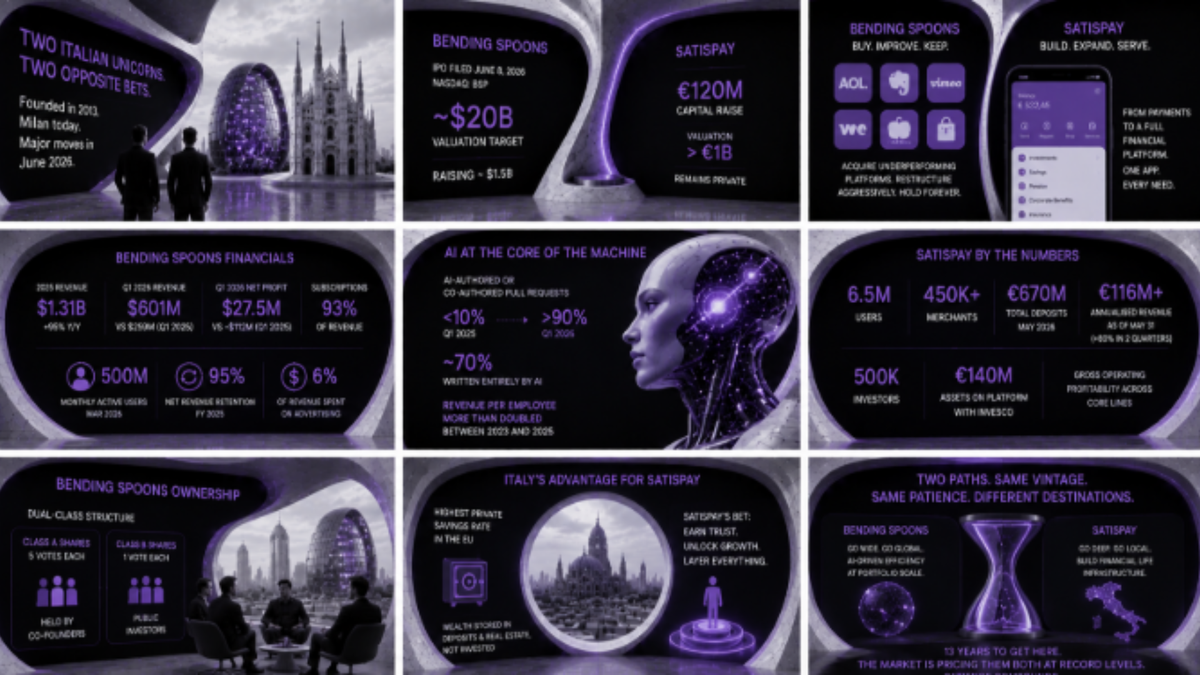
Italy's 2013 startup vintage produced two companies that nobody outside their early investors noticed at the time. One set out to fix how Italians pay each other. The other set out to rescue underperforming apps. Both were founded the same year, both are now based in Milan, and both have just made major capital market moves within days of each other.
The Bending Spoons initial public offering (IPO) filing targets a $20 billion Nasdaq valuation. Satispay's €120 million capital raise keeps it private and pointed at becoming Italy's universal financial platform. The choices they made to get here share almost nothing.
What Bending Spoons built
Bending Spoons was founded in 2013 in Copenhagen by Luca Ferrari, Francesco Patarnello, and Matteo Danieli, who used $40,000 left over from a failed prior venture as seed capital. The company relocated to Milan in 2014 and pivoted from building apps to buying them. It filed its F-1 with the SEC on June 8, 2026, seeking to raise approximately $1.5 billion and list on the Nasdaq Global Select Market under the ticker BSP. The implied valuation of around $20 billion is nearly double the $11.7 billion set during an October 2025 funding round.
The business model is acquisition and compression. Bending Spoons buys underperforming digital platforms, AOL, Evernote, Vimeo, WeTransfer, and Eventbrite among them, and restructures them aggressively. What remains is a leaner version of the original asset, extracting more revenue from a smaller base. The company's own F-1 describes the approach as closer to private equity than to traditional software development, with one structural difference: Bending Spoons acquires with the intention of holding permanently, not selling.
Full-year 2025 revenue reached $1.31 billion, up 95% year-on-year, and has more than tripled since 2023. In Q1 2026, revenue came in at $601 million against $259 million in the same period of 2025, and the company swung from a net loss of $112 million to a net profit of $27.5 million. Subscriptions account for 93% of revenue. Net revenue retention for 2025 was 95%. Monthly active users grew from 111 million in December 2023 to 500 million in March 2026. The IPO uses a dual-class share structure: Class A shares carry five votes each and are held by the co-founders, while public investors receive Class B shares with one vote.
The AI model inside the machine
The F-1 contains a figure that separates Bending Spoons from most companies that talk about artificial intelligence. The share of software pull requests authored or co-authored by AI rose from under 10% in Q1 2025 to over 90% in Q1 2026, with approximately 70% written entirely by AI. Revenue per employee more than doubled between 2023 and 2025.
The effect compounds because the company operates on shared infrastructure. Any AI capability built once, a pricing optimisation, an engineering workflow, a support automation, gets deployed across every product in the portfolio simultaneously. The result is that enterprise AI adoption at this scale is already visible in the income statement rather than being a forward projection. Bending Spoons spent 6% of 2025 revenue on advertising; organically acquired customers generated 79% of new-customer revenue.
What Satispay is building instead
Satispay was founded in January 2013 in Cuneo by Alberto Dalmasso, Dario Brignone, and Samuele Pinta. Its capital raise announcement, published June 11, 2026, describes a €120 million capital raise offered as an option to existing shareholders. Around half is already backed by commitment from three existing investors: Greyhound, Addition, and Lightrock. The round confirms a valuation above €1 billion. Satispay is not going public.
The strategy is to turn a payments app into a comprehensive financial technology platform. The company has 6.5 million users and more than 450,000 affiliated merchants, with total deposits reaching €670 million by May 2026. Annualised revenue exceeded €116 million as of May 31, reflecting 80% growth over the preceding two quarters, and the business has reached gross operating profitability across its core lines: payments, corporate welfare, and value-added products. The new funds will finance the launch of stock and ETF trading directly within the app, a supplementary pension product, and potential acquisitions.
The underlying bet is specific to Italy's structure. The country carries one of the highest private savings rates in the European Union, with household wealth concentrated in deposits and real estate rather than financial products. Satispay already has 500,000 investors holding €140 million in assets on the platform, built since launching investment services in partnership with Invesco earlier in 2026. The fintech thesis here is about depth: earning the trust of a market that saves heavily but invests little, then layering every financial product onto that trust.
Two models, one conclusion
Bending Spoons went wide and global: acquire undervalued assets, make them efficient using AI, and repeat across a growing portfolio. Satispay went deep and local: build proprietary infrastructure inside one underserved market, then layer financial services onto a base of people who use the app daily. Each model is working on its own terms, and seeing them reach the same point in the same week makes the common factor harder to dismiss.
Both companies took thirteen years. Both founders, on separate occasions in separate contexts, said they were not rushing. In 2026, the market is pricing both of them at record levels simultaneously, and the patience they share is the variable that most financial analysis of either company leaves out.
Editor's note
Every piece published on The Bright Minded goes through careful verification, but mistakes can happen. If you spot an error, have additional information, or want to flag anything, write to rosalia@thebrightminded.com.