ATL Saathi: India Gives 100 Schools an AI Assistant Built for the Teacher
Atal Innovation Mission and Google DeepMind launched ATL Saathi, a Gemini assistant for Atal Tinkering Lab teachers, piloting in 100 schools across India.
The Bright Recap
Atal Innovation Mission and Google DeepMind launched ATL Saathi on 14 July 2026. It is a Gemini 3.5 Flash web application that acts as a round-the-clock planning and training assistant for the educators running India's Atal Tinkering Labs, and the live pilot covers 100 schools in eight languages.
To know more about this topic, read our related articles:
- When a state puts AI in classrooms
- What reduced administrative load really measures
- A vendor training a national workforce
- Financial technology explained
Bright Answers
What is ATL Saathi?
ATL Saathi is a Gemini-powered web application launched by Atal Innovation Mission with Google DeepMind on 14 July 2026. It gives teachers in India's Atal Tinkering Labs a round-the-clock planning and training assistant covering 12 curriculum modules, project generation for 10 of them, and support in eight languages.
Is ATL Saathi used by students or by teachers?
By teachers. Every feature is addressed to the educator, including project generation, assembly guidance and safety instructions, and the pilot runs in an initial cohort of 100 schools.
ATL Saathi is an assistant built for adults. Atal Innovation Mission (AIM) and Google DeepMind launched it on 14 July 2026 as a live pilot in 100 schools, and every feature inside it speaks to the teacher standing beside the equipment rather than the child using it.
India's Atal Tinkering Labs (ATL) already reach more than 1.1 crore students, roughly 11 million, with 3D printing, robotics and Internet of Things (IoT) hardware. The scarce resource in those rooms was the person qualified to switch it on.
Meet Cantica, the Fin-Tech intelligence layer behind The Bright Minded.
The equipment arrived before the confidence to use it
AIM, which sits inside the government policy body NITI Aayog, describes the current stage of the programme as a move away from supplying physical lab infrastructure and towards outcomes that show up in student work. That reframing is an admission about what the first stage produced.
A school can hold a microcontroller kit and a 3D printer and still leave both in the cupboard if the teacher assigned to the lab has never used one and has nobody to ask at nine in the evening while preparing tomorrow's session. Countries that have put AI directly into classrooms have tended to start with the student, which makes India's choice of user the interesting part of this launch.
What ATL Saathi actually does for a teacher preparing a lesson
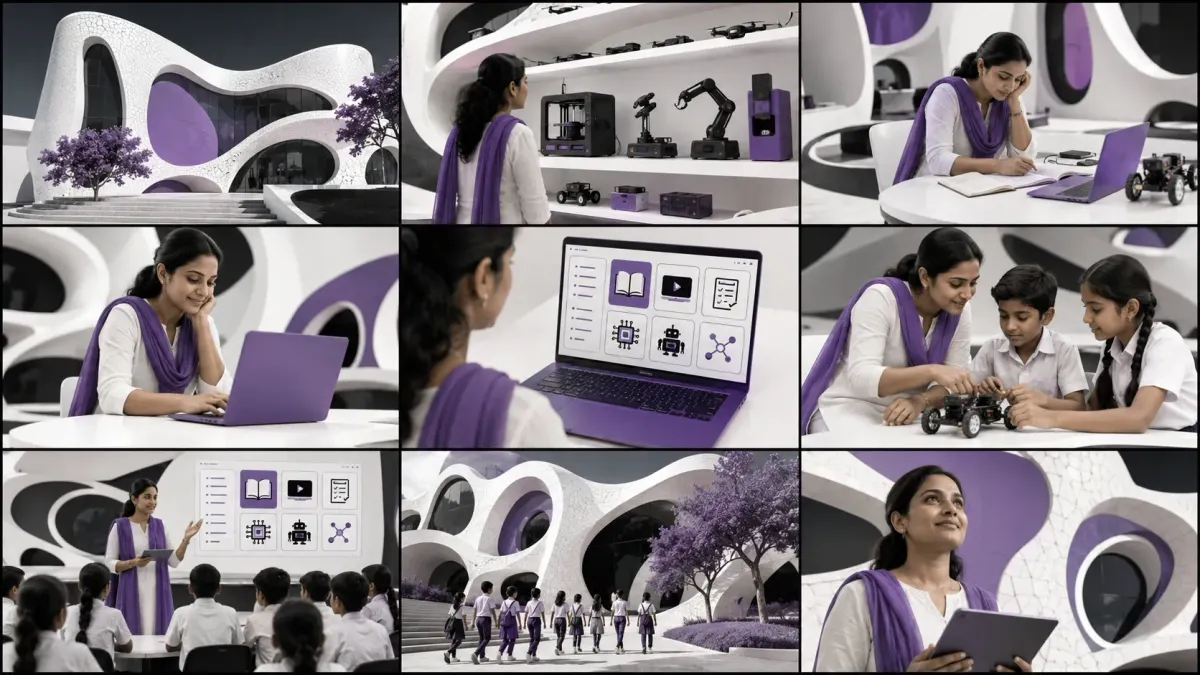
The assistant runs on Gemini 3.5 Flash and keeps ATL training material inside NotebookLM, so the version a teacher opens is the current one. Twelve core modules arrive as condensed summaries with infographics, video overviews and quizzes, which replaces hours of training footage with units short enough to absorb between classes. Ten of those modules carry a project generator that runs in two directions.
A teacher who needs a starting point can ask it to produce lesson projects pitched at the right school year and tied to the syllabus. A teacher facing a student who has arrived with their own problem gets the opposite service, meaning the wiring, the build sequence and the safety warnings needed to attempt it without anyone getting hurt. The tool starts in eight languages and answers in whichever one the teacher writes in, which matters in a school system where the syllabus and the classroom often run in different tongues.
Guardrails are easier to design around a professional
At the AI Impact Summit in February 2026, Google DeepMind committed to two things in Indian education, a Gemini layer inside teacher workflows and a protected student assistant anchored to national curriculum standards. Five months later, the product that shipped is the first of the two. Placing a professional between the model and the child resolves several problems at once, since a teacher can catch a wrong answer, refuse an unsafe instruction, and carry the accountability that no assistant can hold.
Deepak Bagla, AIM's mission director, presented the tool as a way of putting knowledge and context within easy reach of educators so that their attention returns to mentoring, and connected it to the government's Viksit Bharat 2047 goal of turning innovation into a mass movement. The design follows that logic exactly. The adult remains the interface, and the model becomes the thing the adult consults in private.
The same instinct appears wherever AI enters a regulated institution
Institutions carrying a duty of care rarely hand a model straight to the person they are responsible for. They hand it to the professional who already carries that responsibility, whether that professional is a clinician, a compliance officer, or a teacher supervising thirty children around a soldering iron. Anyone tracking how financial technology firms have deployed AI internally will recognise the sequence, because the assistant almost always faces the employee handling the case long before it faces the customer. India has applied that instinct to a classroom, and the reasoning holds better there than in most of the places it was borrowed from.
One hundred schools is the honest number
The pilot covers an initial cohort of 100 schools, a figure that sits against a lab network reaching over 1.1 crore students. DeepMind states what it hopes the pilot will show, namely teachers reporting a lower administrative burden, higher efficiency and greater readiness to help students build things. Those are self-reported measures, and self-reported measures are where administrative time savings tend to look better on a survey than they do in a timetable. The number worth watching is how many student projects reached a working prototype in a lab that produced none last year.
The dependency arrives with the capability
A company supplying the model to a national education mission is doing something close to what happens when a technology firm becomes a national workforce development partner, with the same benefits and the same lock-in written into the arrangement. AIM owns the curriculum, the pedagogy and the schools. Google owns the intelligence that now sits inside the teacher's preparation, in eight languages, at every hour a teacher might need it.
Access to a machine has never taught anybody to build anything, and India has just concluded that the fastest route to eleven million young builders runs through the confidence of the adult holding the room.
Editor's note
Every piece published on The Bright Minded goes through careful verification, but mistakes can happen. If you spot an error, have additional information, or want to flag anything, write to rosalia@thebrightminded.com.