
Wero at Money20/20: Europe's Payment Sovereignty Project Is No Longer Theoretical
Wero's CEO takes the stage at Money20/20 Amsterdam tomorrow. Europe's push to pay without Visa, Mastercard, or PayPal has moved from policy ambition to live product.
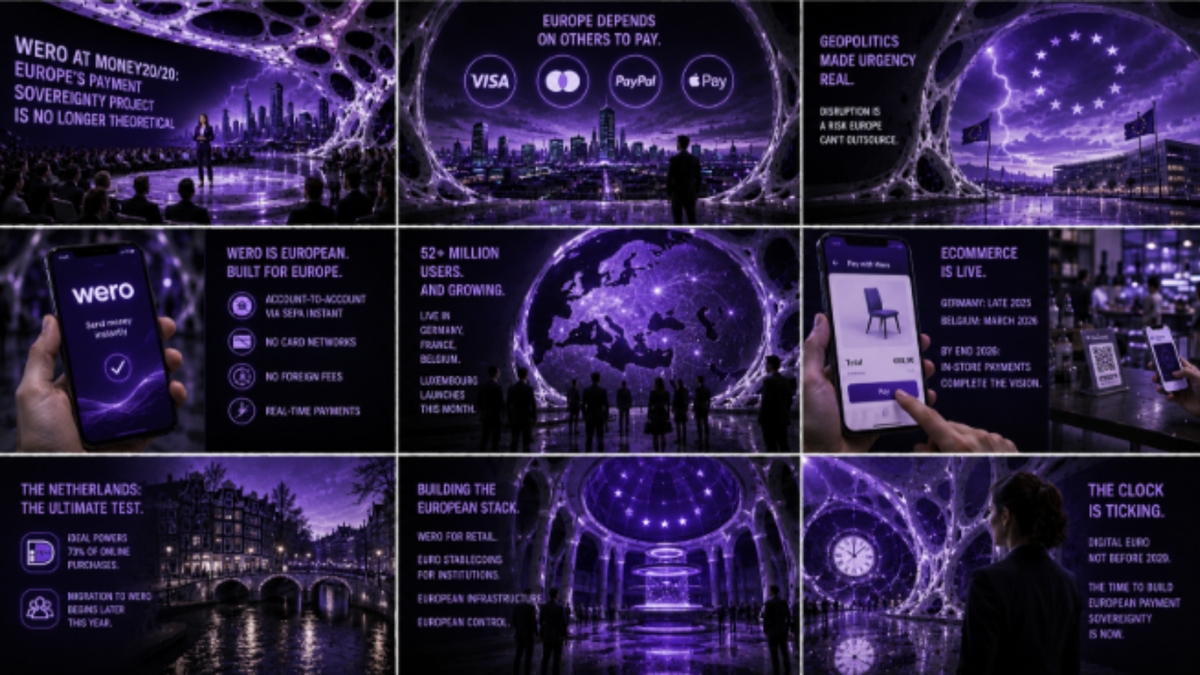
European payment infrastructure has a geography problem. Visa, Mastercard, PayPal, and Apple Pay process the overwhelming majority of European consumer transactions, and none of them are European companies. Tomorrow, June 2, EPI CEO Martina Weimert takes the stage at Money20/20 Amsterdam with a product that is, for the first time, a genuine structural alternative to that arrangement.
Wero, the digital wallet backed by 16 European banks and now more than 1,100 member institutions, has reached over 52 million registered users across Germany, France, and Belgium since its P2P launch in mid-2024. E-commerce payments went live in Germany in late 2025 and in Belgium in March 2026. Luxembourg launches this month. The Netherlands migration from iDEAL begins later this year, bringing one of Europe's most deeply embedded domestic payment habits into the pan-European system.
Why urgency arrived from outside
EPI was founded in 2020 on a technical and competitive rationale: Europe needed a payment layer it owned. Geopolitics delivered the urgency that years of policy debate had not. In a March 2026 interview, Weimert confirmed that large European merchants had cited protection against international disruption as a specific reason for adopting Wero, and described the scenario of European access to US payment systems being interrupted as a concrete, not hypothetical, risk. ECB President Christine Lagarde and Executive Board member Piero Cipollone have each raised the same concern in public: European consumers spend in euros through infrastructure that answers to decisions made in the United States or China.
The euro stablecoin infrastructure taking shape through Qivalis and the MiCA licensing milestone reached by Zerohash Europe in May sit within the same broader architecture. Wero covers the consumer-facing payment layer, while regulated euro token infrastructure handles institutional settlement. Together they describe a payment system that does not need to route through New York or San Francisco.
What Wero does and where it still needs to go
Wero is an account-to-account solution built on SEPA Instant Credit Transfer rails, meaning no card network processes the transaction and no interchange fee travels to a non-European company. Transfers happen via phone number, QR code, or in-app flow in real time. By end of 2026, EPI plans to extend the solution to point-of-sale payments, at which point Wero will cover the full range of retail transaction types: peer-to-peer, e-commerce, and in-store.
The Netherlands is the most consequential test ahead. Dutch merchants currently handle 73% of their online purchases through iDEAL, a domestic system that has been running since 2005. The migration to Wero involves a technical integration that is well within reach for most merchants. Changing the payment behaviour of millions of consumers who have used iDEAL their entire adult lives is a different order of problem entirely.
The clock Weimert is watching
The ECB's digital euro, the institution's own long-run answer to European payment dependency, is not expected before 2029. Weimert has told the Financial Times that she considers this timeline a problem, given how quickly the geopolitical conditions driving demand for Wero could evolve. The fintech infrastructure decisions Europe is making now carry real concentration risk if the underlying system does not reach sufficient scale before the circumstances that made it urgent become acute.
Wero arrives at Money20/20 with 52 million users, a live e-commerce product, and a geopolitical tailwind that no amount of marketing could have manufactured. The question it cannot yet answer is whether European consumers will change a habit that works perfectly well for them today, before they have a reason to.
Editor's note
Every piece published on The Bright Minded goes through careful verification, but mistakes can happen. If you spot an error, have additional information, or want to flag anything, write to rosalia@thebrightminded.com.