
The Trust Ceiling: Why the World’s Biggest Fintechs Are Buying Real Estate
Fintechs are bringing physical presence back to digital banking as deeper financial relationships expose the limits of a purely digital institution and create a new trust ceiling.
The Bright Recap
As fintechs made financial services increasingly independent of physical infrastructure, their relationship with real estate is now beginning to change.
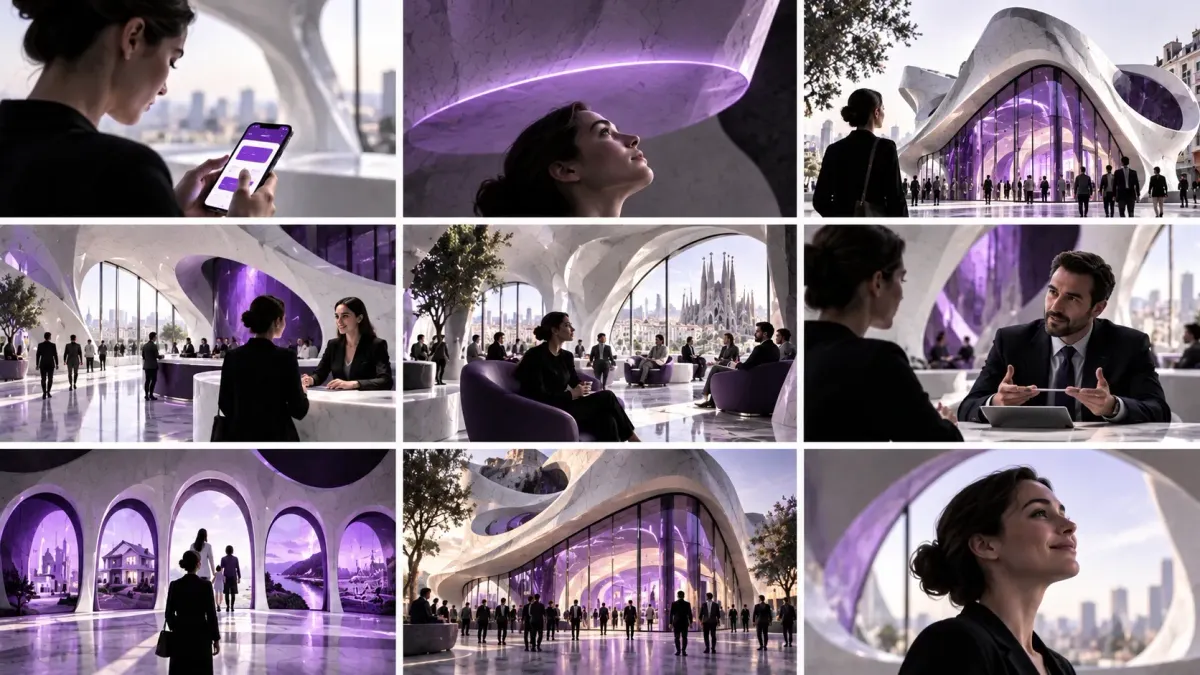
From Revolut’s Barcelona storefront to Nubank’s Ultravioleta Lounge, the new physical spaces are not traditional bank branches rebuilt: they reflect a different role for physical presence, centred on institutionalisation, brand, customer relationships and the trust ceiling of a purely digital financial institution.
To know more about this topic, read our related articles:
- Revolut Barcelona Store: Why the World's Most Valuable Digital Bank Is Going Physical
- Financial technology explained
- Cantica Business Reports
Bright Answers
Why are fintechs investing in physical locations?
Fintechs are investing in physical spaces as they expand beyond everyday payments into deeper financial relationships. Physical locations can give digital institutions a tangible presence, communicate permanence and strengthen the relationship between the brand and its customers.
Are fintechs bringing back traditional bank branches?
Not exactly. The new generation of fintech spaces is generally not designed around teller services, paperwork or routine transactions. Instead, locations such as Revolut’s Barcelona storefront and Nubank’s Ultravioleta Lounge are built around brand, experience and customer relationships.
What is the “trust ceiling” for fintechs?
The trust ceiling describes the potential limit a purely digital fintech may encounter as it tries to become a customer’s primary financial institution. Digital infrastructure can remove transactional friction, but physical presence may help communicate institutional permanence and make a digital financial company more tangible.
Fintech companies are increasingly realising that trust, if not paired with physical presence, acts as a trust ceiling. If these companies were born to remove the difficulties of legacy institutions and to facilitate transactions in a digital-first world, today, being digital is so normal that physical presence is becoming the real disruption.
To disrupt once again in the history of finance, fintechs are increasingly choosing physical presence — if it fits their business strategies.
Meet Cantica, the Fin-Tech intelligence system for custom reports to strategise your next business move.
What does the physical presence of fintechs mean
The central promise of fintech was that financial services no longer needed a building. The bank could be reduced to an app, a card and an interface. By removing branches and much of the infrastructure associated with traditional banking, digital challengers could lower costs, move faster and reach customers with far fewer geographical limitations than a physical network.
That model worked particularly well for everyday transactions. The interaction is immediate and the product is easy to understand. And, more importantly, it doesn't need the physical branch to be next to you.
The problem becomes different when the financial relationship becomes more complex. A current account into which a salary is paid, a large cash balance, a mortgage, an investment portfolio or a substantial credit line requires a different kind of relationship between customer and institution. At that point, the customer wants to know whether the institution feels sufficiently established to hold a larger part of a customer's financial life. If the majority of users, especially of younger generations, still feel comfortable with a digital-only presence even for more complex relationships, the need for a physical, grounded presence becomes more necessary for many reasons.
First off, a physical place gives a fintech the appeal of an institution. We are witnessing this with the institutionalisation of major cryptocurrencies: born as an alternative to traditional financial means in a trustless environment, institutionalisation is what is giving them more volume and diffusion. The same occurs with fintechs: as our use moves from low-volume daily transactions to a meaningful part of our financial lives, fintechs start seeing the upsides of institutionalisation.
Second, a branch is obviously more costly, transmitting the idea of economic solidity before the eyes of users.
Third, and this might be the more psychological aspect, in an increasingly digital-only world people perceive the physical presence as a more meaningful experience. Under a business perspective, this might translate into a closer connection and relationship between the fintech itself and the customer, further fostering user retention and trust. This is exactly the trust ceiling a fintech that necessarily stays only digital by purpose might encounter.
Software can remove transactional friction, but it cannot automatically create the emotional and institutional confidence required for a customer to make a digital challenger their primary financial institution.
The response is beginning to appear in an unexpected place: real estate.
The behavioral wall of the pure-play digital app
Lower costs and an easier user experience proved that fintechs did nothing wrong in considering certain processes obsolete. Digital onboarding, mobile payments and app-based account management allowed customers to perform most routine banking activities without ever entering a long-lasting conversation with an operator, dealing with complex processes, or visiting a physical location — which proved particularly useful during Covid.
The psychology changes when the stakes increase and when the disruption becomes the new normal. The distinction is now becoming increasingly important as digital challengers attempt to move into more valuable financial products.
Revolut, for example, is moving beyond its purely digital identity with a permanent physical presence in Barcelona. The company has been developing a storefront on Av. del Portal de l'Àngel, using a retail format that is closer to the experiential environments associated with technology companies than to the traditional bank branch.
Nubank has taken the physical concept in another direction. Its Ultravioleta Lounge at São Paulo's Guarulhos International Airport occupies three floors and more than 1,000 square meters, creating a physical environment around a premium product that otherwise lives primarily inside the Nubank app.
These spaces are not being built because fintechs suddenly need somewhere to process ordinary transactions. They are being built because physical presence can make a digital institution tangible.
The secondary card trap
The underlying problem becomes clearer when looking at the economics of a fintech customer.
Having millions of users is valuable, but the headline number does not necessarily tell us how important the institution is in each customer's financial life. A user can have a fintech card, use it regularly and still keep their salary account, savings, mortgage and investments with a traditional bank. This is the secondary-card problem.
If the fintech remains primarily a spending product, its ability to generate revenue is concentrated around relatively low-margin transactional activity. To deepen the relationship, it needs customers to adopt more complex products, including credit, mortgages, savings and wealth management. Those products are different from a payment card because the customer is entrusting the institution with a much larger part of their financial life.
This is also where the economics of fintech begin to change. The original digital model was designed to eliminate physical overhead, but if the next stage of growth requires stronger institutional trust, some of the capital that previously went almost entirely into software, engineering and customer acquisition can begin flowing into physical environments, premium service and face-to-face interaction.
The branch is therefore returning in a different form. The objective is to recover some of the physical reassurance that comes with a building.
The infrastructure layer: Stripe, Monzo and the physical economy
The development becomes even more interesting when viewed alongside what is happening underneath the consumer-facing layer of fintech.
Stripe has helped turn financial infrastructure into something that can increasingly be consumed as software. Its fintech offering covers payments, payouts, card issuance, money movement and other financial functions through APIs and integrated tools. Stripe describes this infrastructure as a way for fintechs to build and scale without having to recreate the underlying financial stack themselves.
This is the opposite direction from the physical real-estate trend. The infrastructure layer is becoming increasingly abstract and invisible, while the consumer-facing layer may need to become more tangible.
That distinction is important because infrastructure itself is becoming less of a differentiator. If financial capabilities can increasingly be accessed through standardized infrastructure, the customer-facing company needs other ways to establish a distinctive relationship with its users.
Monzo illustrates how the two layers can connect. Monzo has partnered with Stripe to give its business customers access to contactless payments through their smartphones. Its Stripe integration includes Stripe Connect and Tap to Pay on iPhone, allowing businesses to accept physical card and digital-wallet payments without additional payment hardware.
This demonstrates how the digital financial account is increasingly being connected to activity in the physical economy. The software remains the interface, but the financial relationship increasingly extends into real-world businesses, merchants and physical transactions.
The return of the physical flagship
This helps explain why the new generation of fintech spaces does not look like the bank branches they are replacing. Traditional branches were designed around operational banking: teller counters, paperwork, cash handling and account servicing. The new spaces are designed around the brand and the relationship with the customer.
Revolut's Barcelona location fits into this logic. A prominent storefront gives the company something it did not have as a purely digital institution: a permanent physical address that customers can associate with the brand.
Nubank's Ultravioleta Lounge takes the same principle into a premium setting. The lounge is explicitly connected to the Ultravioleta proposition and provides customers with an experience that goes beyond what the financial app itself can offer.
The physical environment therefore becomes part of the product rather than merely a distribution channel for it.
The trust ceiling
The technology that made digital banking possible also made the physical institution less necessary for everyday transactions. But as fintechs move toward the products that generate deeper and potentially more valuable customer relationships, the absence of a physical institution can become more significant.
The industry therefore appears to be separating two functions that the traditional bank branch used to perform simultaneously.
The first is operational, the one largely replaced by digital infrastructure.
The second is psychological and institutional. A physical location can give customers a visible representation of the company, provide access to people and services, and communicate a sense of permanence that an app alone may struggle to convey.
This is why the current investment in physical spaces should not necessarily be interpreted as fintechs abandoning their digital model. It is more accurately a response to the limits of that model when the financial relationship becomes deeper.
Editor's note
Every piece published on The Bright Minded goes through careful verification, but mistakes can happen. If you spot an error, have additional information, or want to flag anything, write to rosalia@thebrightminded.com.