
Shift4 Payments Shareholders Reject 20% of Executive Pay Package
Shift4 Payments shareholders voted against 20.6% of executive compensation and withheld 13.6% support from director Nancy Disman at the June 2026 meeting.
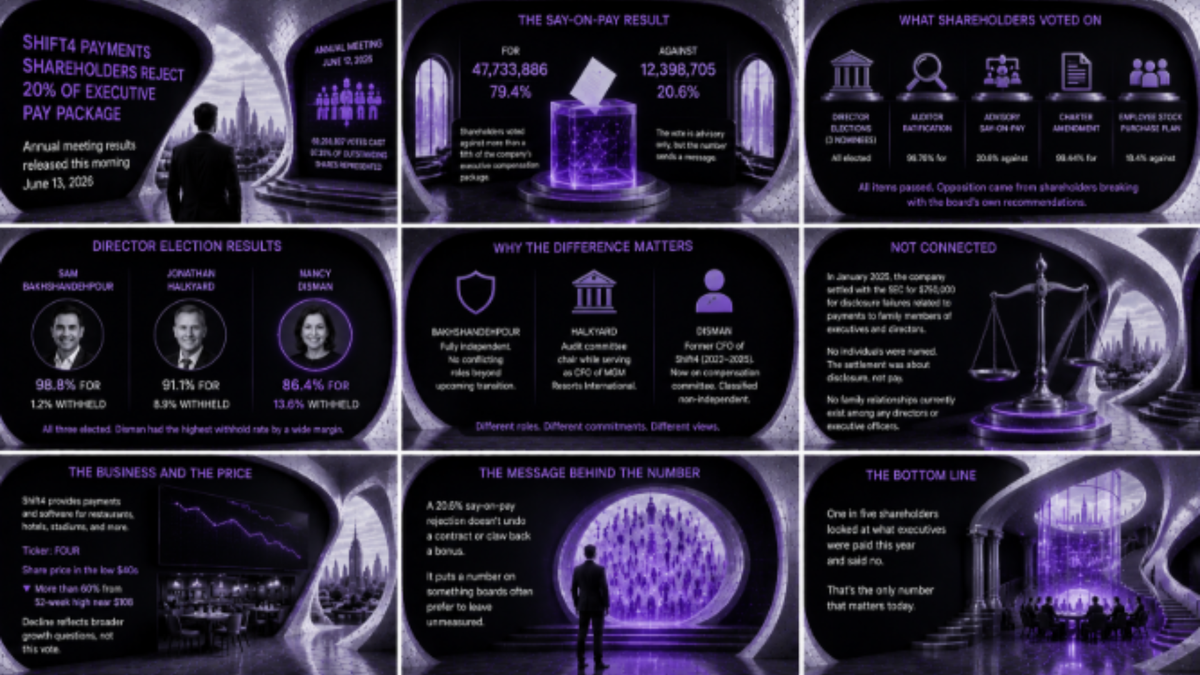
Shift4 Payments shareholders voted against more than a fifth of the company's executive compensation package at its annual meeting on June 12, a result the company disclosed this morning in a routine filing that contained anything but a routine number.
Of the votes cast on the say-on-pay proposal, 20.6% opposed it, a level of dissent that sits well outside what passes through most shareholder meetings unnoticed. The same meeting saw one of three director nominees, Nancy Disman, pull a withhold rate of 13.6%, more than ten times higher than the 1.2% recorded against her fellow nominee Sam Bakhshandehpour.
A say-on-pay vote exists because of a rule Congress wrote into the Dodd-Frank Act in 2010, requiring publicly traded companies to let shareholders weigh in periodically on how much their top executives are paid. The vote itself carries no legal weight. A company can lose it by a wide margin and pay its executives exactly the same amount the following year, since the result is advisory rather than binding. What it does do is put a number on shareholder sentiment that a board's compensation committee is required to consider, and a large enough number tends to get noticed by the institutional investors who track these things across an entire portfolio.
Shift4, a fintech company whose point-of-sale and payment-processing systems run behind the scenes at restaurants, hotels, and stadiums, held the meeting virtually, with shareholders representing 87.35% of the company's outstanding stock taking part, a turnout of 69,298,837 shares out of 79,328,897 outstanding as of the April 13 record date. The board had recommended a unanimous "for" vote on every item on the agenda. All five passed. The opposition that did surface came entirely from shareholders breaking with the board's own recommendation, not from any split inside it.
What shareholders actually voted on
Five items went before the meeting: the election of three Class III directors to three-year terms, ratification of PricewaterhouseCoopers as auditor, the advisory say-on-pay vote, a charter amendment eliminating the company's now-unused Class B and C stock structure while adding officer liability protections, and a new employee stock purchase plan.
Auditor ratification cleared with 99.76% support and the charter amendment with 99.44%, the kind of margins that reflect no real friction. The ESPP drew more resistance than usual, with 18.4% of votes cast against it.
The say-on-pay result stands apart from all of that. Shareholders cast 47,733,886 votes in favor of the compensation package and 12,398,705 against it. The proxy statement Shift4 filed ahead of the meeting asked shareholders to support the pay structure on the grounds that it rewarded the achievement of company goals and matched what the board considered shareholders' own priorities. Roughly one in five voting shareholders disagreed.
A director vote that splits along one clear line
The three Class III nominees, Bakhshandehpour, Jonathan Halkyard, and Disman, were all elected, since director elections at Shift4 require only a plurality of votes cast rather than majority support. But the size of the gap between them is the part worth sitting with. Bakhshandehpour cleared with 98.8% support and a withhold rate of just 1.2%. Halkyard drew a withhold rate of 8.9%. Disman's withhold rate reached 13.6%, the highest of the three by a wide margin.
That spread lines up with a structural difference among the three nominees rather than anything random. Bakhshandehpour is a fully independent director with no overlapping demands on his attention beyond a February 2026 move from CEO of José Andrés Group to a new role as President of Local Merchants at Bilt Technologies, a transition that evidently gave shareholders no pause. Halkyard sits as Shift4's audit committee chair while simultaneously serving as the sitting chief financial officer of MGM Resorts International, a position he holds under an employment agreement signed in September 2025 running through 2029. Carrying a full-time CFO role at one public company while chairing the audit committee of another is exactly the kind of dual commitment that institutional shareholders and proxy advisors tend to weigh when assessing whether a director has the bandwidth a committee chair role demands.
Disman's situation differs from both. She served as Shift4's own chief financial officer from August 2022 until September 2025, when she stepped down after three years in the role, telling investors on the company's earnings call that month that the move had taken real thought. She remained with the company as a senior advisor through the start of this year and continues today as an independent advisor while sitting on the board's compensation committee, the same committee responsible for the pay package shareholders voted against by a 20.6% margin in this same meeting. The proxy statement classifies her as non-independent under NYSE listing rules specifically because of her relationship with the company, a designation the other two nominees do not carry.
What this isn't
Shift4 carries a documented history with the Securities and Exchange Commission (SEC) on a separate disclosure matter: a January 2025 settlement, covering proxy statements filed between 2021 and 2023, in which the company paid a $750,000 penalty for failing to disclose roughly $4.7 million in compensation and commission payments to siblings, children, and a stepchild of certain executives and directors. That settlement named no individuals and made no finding about executive pay itself, only about disclosure.
This year's proxy statement states directly that no family relationships currently exist among any of the company's directors, executive officers, or nominees. The settlement and this week's vote sit alongside each other in the company's recent history. Nothing in the public record connects them as cause and effect, and reading them that way would overstate what either document actually says.
What the record does support is narrower and more concrete: a company entering a proxy season with one director whose own former executive role keeps her formally classified as an insider, sitting on the committee that just saw its work rejected by a fifth of the shareholders who voted on it.
Shift4 trades under the ticker FOUR, currently changing hands in the low $40s after a slide of more than 60% from its 52-week high near $108, a decline that long preceded this meeting and reflects broader questions about organic growth rather than anything specific to this vote. The compensation dispute and the share price are separate stories that happen to be unfolding in the same company at the same time, which is itself worth noticing without forcing the two into a single narrative they don't support.
A 20.6% say-on-pay rejection doesn't undo a contract or claw back a bonus. What it does is put a number on something boards often prefer to leave unmeasured: how many of the people who own the company looked at what its executives were paid this year and said no.
Editor's note
Every piece published on The Bright Minded goes through careful verification, but mistakes can happen. If you spot an error, have additional information, or want to flag anything, write to rosalia@thebrightminded.com.