MiCA's Hidden Fragility: What a UniCredit Warning Reveals About Europe's Stablecoin Bet
UniCredit's deputy vice chair warned Europe cannot replicate the US deposit backstop that saved crypto markets in 2023. MiCA makes the gap harder to ignore.
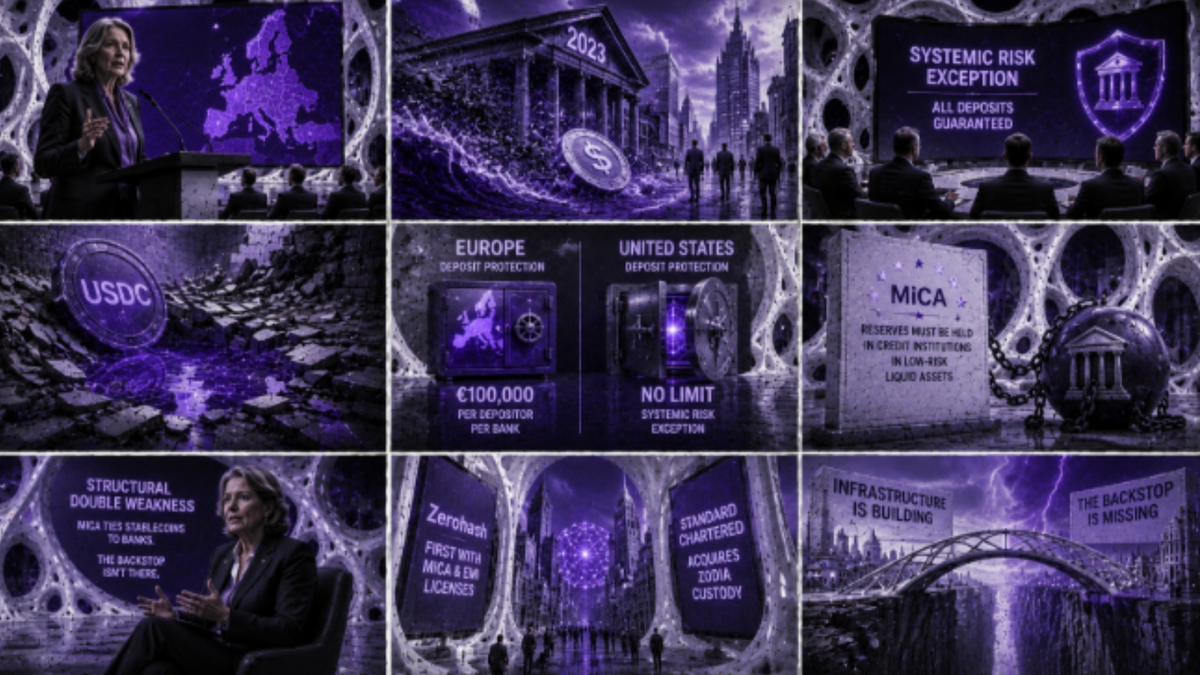
Europe's most comprehensive crypto regulation has a structural problem inside it. Reuters reported it first. On May 28, Elena Carletti, deputy vice chair and head of the board's risk committee at UniCredit, said at an IESE Business School conference in Madrid that Europe may struggle to contain a financial shock tied to crypto firms and banks. The concern is specific: the mechanism US regulators used in March 2023 to stabilise crypto markets after Silicon Valley Bank collapsed cannot be replicated under European law.
What happened in 2023 and why it matters now
SVB held deposits backing several crypto firms. When the bank failed, Circle, the issuer of the USDC stablecoin, disclosed that $3.3 billion of its reserves were held there, according to CoinDesk. USDC briefly lost its dollar peg as redemptions accelerated. US regulators responded by invoking a systemic risk exception that guaranteed all deposits at SVB and Signature Bank, including balances well above federal insurance limits. Crypto markets stabilised.
Europe's deposit guarantee system caps protection at €100,000 per depositor per bank. A stablecoin issuer holding hundreds of millions in reserves at a European bank would not receive equivalent coverage in a comparable crisis. Carletti described the situation as a structural double weakness: MiCA pushes stablecoin issuers closer to banks by requiring reserves to be held in liquid assets including bank deposits, while the insurance architecture that would backstop those deposits in an emergency has not changed.
The problem MiCA created by design
MiCA's reserve requirements for stablecoin issuers are not incidental to this risk. They are the mechanism that produces it. The regulation classifies significant stablecoins as electronic money tokens and requires their reserves to be held in credit institutions, in low-risk liquid assets. That is the rule that ties stablecoin stability directly to bank balance sheets. Without a matching expansion of deposit protection, the connection becomes the channel through which a bank failure transmits into crypto markets.
Carletti said the systemic risk exception used in the US cannot be easily replicated in Europe. The legal architecture is different. The political consensus required to extend blanket deposit protection across an entire currency union, under crisis conditions, is a different problem from what a single national regulator decided over a weekend in March 2023.
The irony inside UniCredit's own position
UniCredit is a founding member of Qivalis, the consortium of 37 European banks building a MiCA-compliant euro stablecoin targeting a launch in the second half of 2026. The institution warning about the structural gap is simultaneously building inside it. That is not contradictory. It reflects what the banking sector has decided: the euro stablecoin market will develop regardless, and the better position is inside the regulated structure rather than outside it. But it does mean the warning carries a particular weight. Carletti is not a critic of MiCA speaking from the outside. She is a senior executive at one of the institutions most committed to making it work.
The European stablecoin infrastructure is assembling at pace. Zerohash became the first company to hold both a MiCA licence and a full Electronic Money Institution licence in Europe on May 18. Standard Chartered moved to absorb Zodia Custody's crypto business in the same week, making the same calculation from the banking side. The compliance layer is being built by institutions that have decided the market is real. What Carletti identified is that the crisis management layer has not kept pace with it.
Editor's note
Every piece published on The Bright Minded goes through careful verification, but mistakes can happen. If you spot an error, have additional information, or want to flag anything, write to rosalia@thebrightminded.com.