
Infinite and CipherOwl: What GENIUS Act Compliance Actually Looks Like When a Fintech Builds for It
Infinite confirmed a single-vendor deal with CipherOwl on June 10, 2026. Here is what it reveals about what GENIUS Act compliance requires in practice.
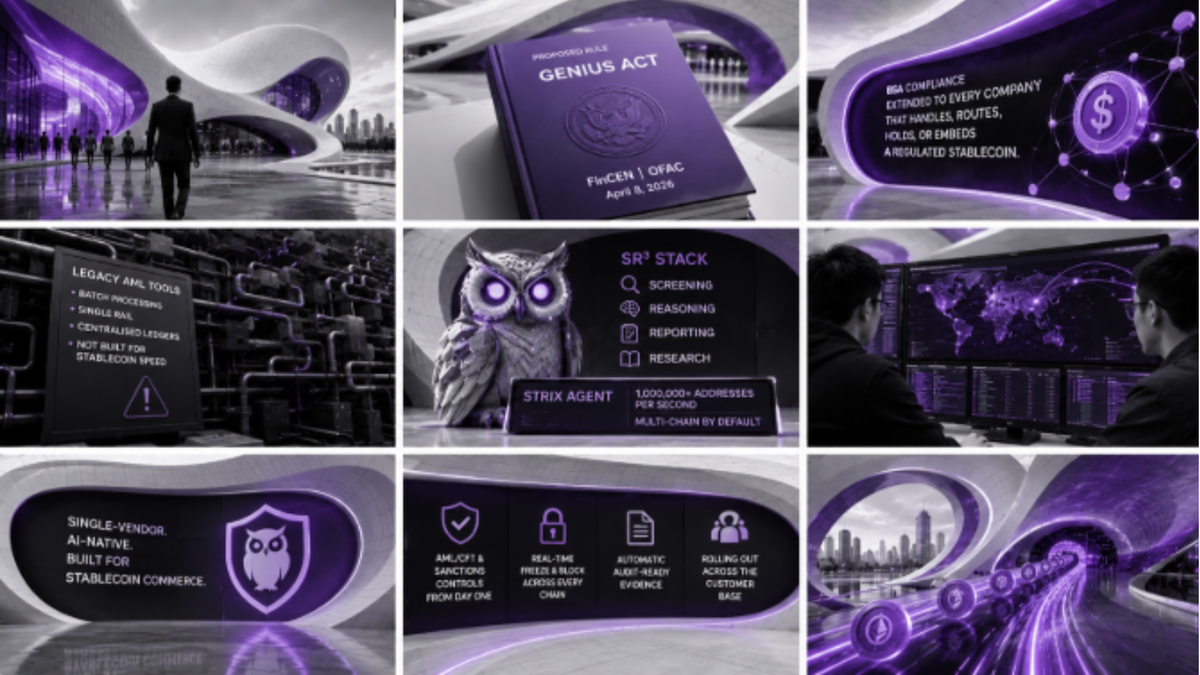
The GENIUS Act proposed rule, published by FinCEN and OFAC on April 8, 2026, extends Bank Secrecy Act compliance requirements to every company that handles, routes, holds, or embeds a regulated stablecoin. This category covers payment processors, embedded finance platforms, and any fintech that routes stablecoin flows as part of its product.
On June 10, 2026, Infinite, a B2B stablecoin payment platform backed by Bessemer Venture Partners, confirmed a single-vendor partnership with CipherOwl that is the first public demonstration of what building for that requirement actually looks like in production.
Why legacy compliance tools cannot do this job
Rules-based Anti-Money Laundering and Counter Financing of Terrorism (AML/CFT) systems were built for a payment environment where transactions move through a single rail, settle in batches, and leave a clean audit trail in centralised ledgers. Stablecoin transactions settle in seconds, run simultaneously across multiple chains, and generate address-level data at volumes no batch-processing system was designed to handle.
The GENIUS Act proposed rule explicitly acknowledges this, noting that legacy tools were not built for stablecoin-speed settlement and stating a preference for AI-driven analytics. The compliance gap is architectural, not a matter of configuration or staffing.
CipherOwl's SR³ Stack, comprising Screening, Reasoning, Reporting, and Research, is paired with its Strix agent and screens over one million addresses per second, multi-chain by default, with explainability built into every output. The company's founders, Leo Liang and Ming Jiang, built Coinbase's internal onchain compliance infrastructure before founding CipherOwl.
Strix operates autonomously at that speed, which puts it directly inside the question that has never had a clean answer in financial compliance: how institutions govern AI agents acting in finance without human sign-off on each decision, and whether their outputs hold up under regulatory scrutiny. CipherOwl's answer is explainability by design and audit-ready evidence as a default output, not an optional feature.
What Infinite's single-vendor decision signals
Infinite confirmed it is deliberately not multi-sourcing from legacy analytics providers. The decision is framed as a product differentiation choice: a single-vendor, AI-native compliance stack purpose-built for stablecoin commerce rather than a legacy AML tool retrofitted to handle it. The intelligence layer went live across Infinite on June 10, beginning with Infinite Accounts, with a planned rollout across the full customer base. Per the launch announcement, customers receive production-ready AML/CFT and sanctions controls from day one, real-time freeze and block capability across every active chain, and automatically generated audit-ready evidence.
The single-vendor logic is worth noting independently of the specific partners involved. A fintech platform that routes stablecoin payments at scale now carries the same compliance architecture obligations as a bank, under the GENIUS Act framework. Adding multiple legacy analytics providers produces fragmented audit trails and inconsistent monitoring coverage across chains. A single AI-native stack with explainable outputs and a defined escalation path is the answer to the evidentiary requirements the rule creates, not a preference for convenience. The stablecoin volume at scale that platforms are now processing makes that architecture decision consequential.
The GENIUS Act created a compliance requirement that legacy tools cannot technically satisfy at stablecoin speed. The first public answer to it was built by people who previously solved the same problem inside one of the largest crypto exchanges in the world, which is a precise measure of how narrow the field of qualified architects actually is, and how far behind the fintech industry's compliance infrastructure currently sits relative to the payment infrastructure it is being asked to monitor.
Editor's note
Every piece published on The Bright Minded goes through careful verification, but mistakes can happen. If you spot an error, have additional information, or want to flag anything, write to rosalia@thebrightminded.com.