
FCA Investigates Mastercard, PayPal, and Visa: The Competition Problem Hidden Inside Your Digital Wallet
The FCA is investigating Mastercard, PayPal, and Visa for suspected anti-competitive conduct over digital wallet funding.
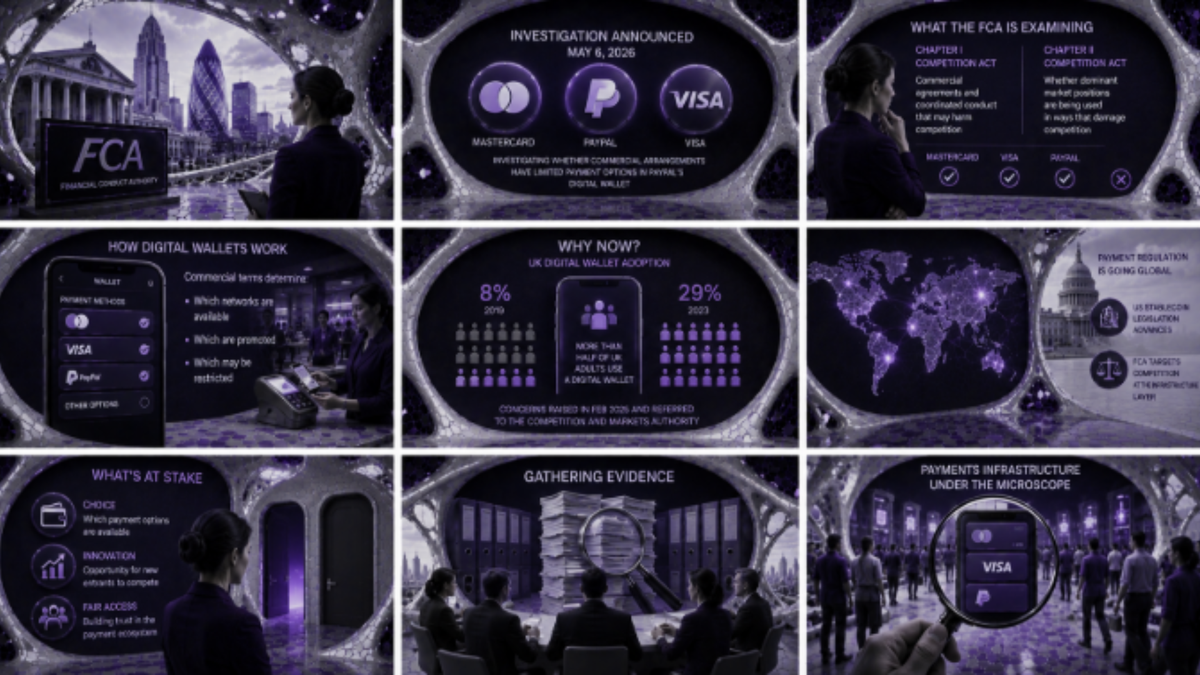
Competition in payments has moved somewhere most consumers never look. The FCA announced on May 6, 2026 that it is investigating Mastercard, PayPal, and Visa under the Competition Act 1998, examining whether commercial arrangements between the three companies have limited the payment options available within PayPal's digital wallet.
The investigation was triggered by PayPal's own financial disclosures, which confirmed the company had received formal notices of inquiry from the regulator in March. The FCA has reached no conclusions and is currently in the evidence-gathering phase.
What the FCA is examining
The investigation runs on two tracks under UK competition law. All three companies face scrutiny under Chapter I of the Competition Act, which targets commercial agreements and coordinated conduct between companies that harm competitive conditions in a market.
Mastercard and Visa face an additional inquiry under Chapter II, which examines whether a company's dominant market position is being used in ways that damage competition. Visa confirmed it had been informed of an inquiry into the contractual terms governing its arrangements with PayPal's digital wallet, and Mastercard confirmed it received a formal information notice requesting details of its contractual relationship with PayPal.
Digital wallets function, in part, through a hierarchy of preferred payment methods loaded at setup. The commercial terms that determine which card networks are available inside a wallet, which are promoted, and which may be restricted are negotiated between PayPal and the card schemes outside of public view.
The FCA's Chapter I concern is that those terms may have been coordinated in ways that reduced competition at the payment funding level. The Chapter II angle, which applies to Mastercard and Visa but not PayPal, targets the possibility that those two card networks leveraged their dominant market positions to restrict how PayPal could operate.
Why this investigation is happening now
The timing reflects how quickly digital wallet adoption has accelerated in the UK. The FCA and the Payment Systems Regulator published a joint feedback statement in February 2025 showing the share of card transactions made through a digital wallet rose from 8% in 2019 to 29% in 2023, with more than half of UK adults now using one. That document flagged competition concerns and shared them with the Competition and Markets Authority to avoid regulatory duplication. The current investigation is the operational consequence of that process.
Payment infrastructure regulation is entering a new phase, with fintech companies and traditional card networks facing scrutiny across multiple jurisdictions. In the United States, the stablecoin oversight debate is advancing legislation that would bring digital payment systems under federal supervision. The FCA's investigation addresses a different layer of the same underlying question: who sets the terms on which digital money moves, and under what constraints. In both cases, the answer is becoming visible through regulatory action rather than market pressure.
The FCA rarely deploys its Competition Act powers against financial services firms, making this probe notable beyond its immediate legal outcome. The commercial arrangements that determine which payment methods are available inside millions of UK digital wallets are now formally visible to a regulator with enforcement authority. That level of scrutiny arrived at the infrastructure layer before it reached the consumers those wallets belong to.
Editor's note
Every piece published on The Bright Minded goes through careful verification, but mistakes can happen. If you spot an error, have additional information, or want to flag anything, write to rosalia@thebrightminded.com.