
US Bitcoin Reserve 2026: The Custody Problem Behind the Coming White House Announcement
The US holds an estimated 328,000 BTC through criminal forfeiture. The White House announcement due in weeks centers on custody, security, and legal authority.
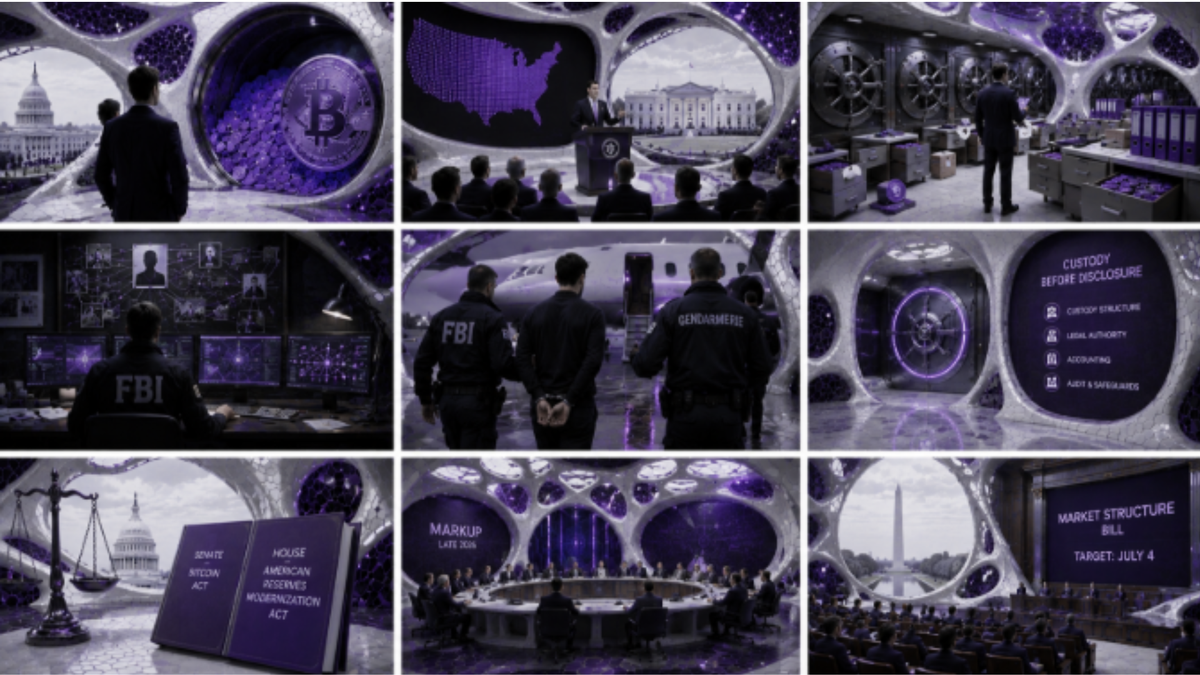
The US government is the world's largest known holder of Bitcoin, a position it arrived at through criminal forfeiture proceedings rather than any investment decision. Public estimates based on blockchain tracking place its holdings at approximately 328,000 BTC, worth around $25 billion at current prices, though the government has not officially confirmed the total. On May 6, 2026, White House digital assets adviser Patrick Witt told the Consensus Miami conference that a major US Bitcoin Reserve update is coming within weeks. His stated reason for the delay was that before the government discloses what it holds, it needs to demonstrate it can actually secure it.
How $25 billion in Bitcoin accumulates without a custody plan
Trump's March 2025 executive order established the Strategic Bitcoin Reserve and directed federal agencies to stop liquidating seized crypto assets, pooling them into a centralized holding structure. The reserve draws solely on Bitcoin forfeited through criminal and civil proceedings; the government has not purchased a single bitcoin for it. For the fourteen months since the order, agencies have been auditing their holdings and working toward centralized custody.
Witt said at Consensus Miami that this work had already uncovered cold wallets stored in desk drawers across federal agencies, a detail that captures the distance between how these assets arrived and what holding them long-term requires.
The theft that made the problem concrete
In January 2026, a pseudonymous blockchain investigator known as ZachXBT published an analysis tracing suspicious on-chain movements from US government-controlled wallets to addresses he alleged were controlled by John Daghita, son of the president of Command Services & Support, a Virginia-based company holding a US Marshals Service contract to manage seized digital assets.
ZachXBT traced the movements using publicly available blockchain records and reported his findings to authorities. On March 4, 2026, Daghita was arrested on the island of Saint Martin in a joint FBI and French Gendarmerie operation, with the FBI alleging he siphoned more than $46 million from government custody wallets from 2024 into early 2026. The company managing those assets held a $4 million government contract.
Custody before disclosure
The upcoming announcement, Witt indicated, will address the government's progress on custody structure, legal authority, and the accounting of its holdings. He declined to confirm total government Bitcoin holdings at Consensus Miami, stating that establishing proper safeguards had to precede any public disclosure.
That sequencing has a specific meaning after the Daghita case: the government had outsourced custody of seized digital assets to a small contractor, and the alleged theft ran for roughly fifteen months before a private investigator found it using the same public blockchain records the government itself had not been monitoring.
Witt framed the case at Consensus Miami as the clearest evidence that digital asset custody requires a fundamentally different institutional approach from the procedures used to manage physical seized property.
The legal foundation that does not yet exist
The reserve has no statutory basis. Trump's executive order can be revoked by any incoming president without congressional action, which is why both Senator Lummis's BITCOIN Act in the Senate and Representative Begich's American Reserves Modernization Act in the House propose acquiring up to one million BTC through budget-neutral mechanisms as a path to codifying the holding in law.
The most realistic vehicle for making the reserve permanent is the National Defense Authorization Act markup expected in late 2026. Separately, the White House is targeting July 4 for House passage of the crypto market structure bill that would define how fintech and digital asset companies operate under federal law, with the Senate Banking Committee markup expected this month. That legislation addresses the regulatory framework broadly and does not codify the reserve itself.
The most precise measure of where the US Bitcoin Reserve actually stands is that its first significant public accountability came from a pseudonymous investigator reading the blockchain records of the asset the government is still working out how to hold.
Editor's note
Every piece published on The Bright Minded goes through careful verification, but mistakes can happen. If you spot an error, have additional information, or want to flag anything, write to rosalia@thebrightminded.com.