CLARITY Act Senate Markup 2026: Why the SEC Chair Who Wants It Announced It at an AI Summit
CLARITY Act markup vote confirmed for May 14, 2026. SEC chair Atkins made his clearest push for it at an AI summit. Here is what that choice signals.
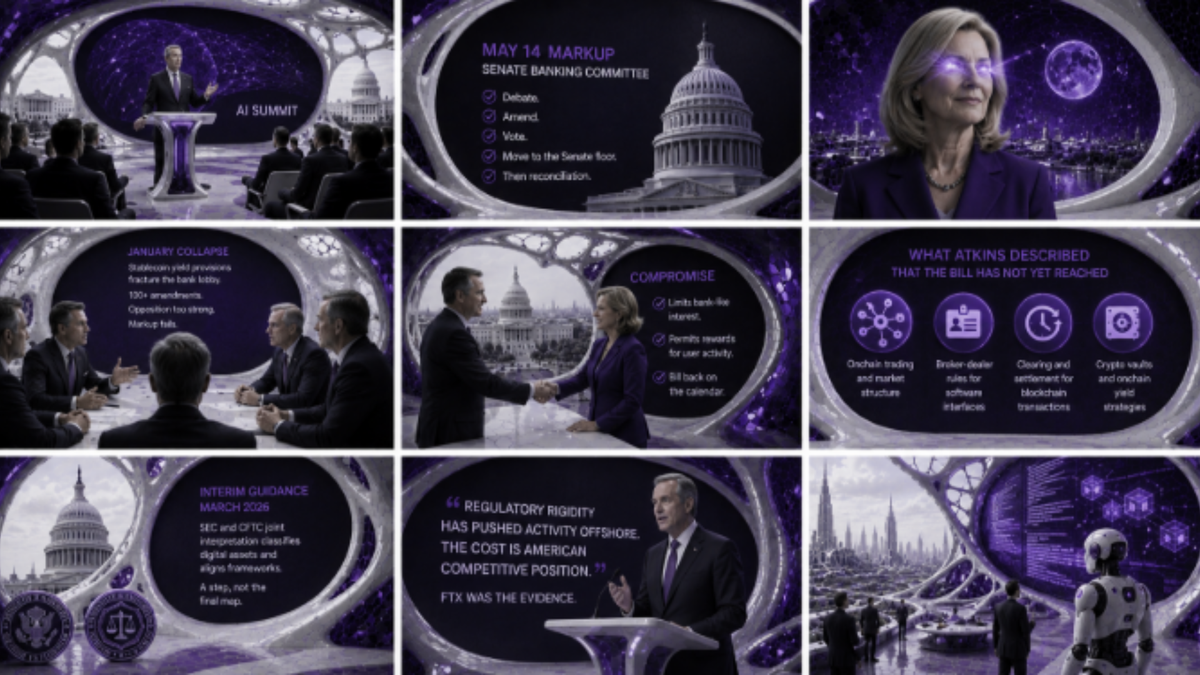
Paul Atkins, chair of the US Securities and Exchange Commission, chose an artificial intelligence conference to renew his public call for the CLARITY Act. His venue was the Special Competitive Studies Project AI+ Expo in Washington on May 8, 2026, where he told an audience of researchers, innovators, and builders that Congress should send the Digital Asset Market Clarity Act of 2025 to President Trump's desk. The Senate Banking Committee confirmed a markup vote for May 14 that same day, putting the Digital Asset Market Clarity Act back on a calendar it fell off in January. Atkins spent a significant portion of his remaining remarks describing digital financial infrastructure the bill was not written to govern.
What the May 14 markup establishes
The May 14 session is a markup, the formal stage at which the Senate Banking Committee debates, amends, and votes on the bill. Committee passage would move the CLARITY Act to the Senate floor for a full chamber vote, followed by reconciliation with the House version, which passed 294-134 on July 17, 2025, before anything reaches the President. What a successful committee vote establishes is that the Senate can move at all, and that distinction carries real weight after January 2026, when a scheduled markup collapsed on the morning it was supposed to begin.
Senator Cynthia Lummis, who chairs the Senate Banking Subcommittee on Digital Assets and has been the bill's most vocal advocate in the Senate, signaled her commitment publicly in the days before the vote by updating her profile with Bitcoin laser eyes, the convention used by long-term Bitcoin holders to communicate conviction in the asset's price trajectory. Her sponsorship of the BITCOIN Act, which proposed a federal Strategic Bitcoin Reserve, makes the gesture consistent with a position she has held in public for years, with Bitcoin trading around $80,000 at the time of the update.

The detour that produced four months of delay
The January collapse came down to the stablecoin yield provisions that fractured the bank lobby, which drew more than 100 amendments and enough opposition to make a vote too risky to hold. Banks argued that stablecoins paying interest-like returns would drain deposits from regulated institutions. Brian Armstrong announced that Coinbase was withdrawing its backing over those same provisions, a position the company later softened after White House conversations it described as constructive. The compromise that put the bill back on the calendar, brokered by Senators Thom Tillis and Angela Alsobrooks, limits stablecoin programs structured like bank interest while permitting rewards tied to user activity.
Democratic offices were still requesting language changes in sections of the draft in the days before the May 14 session, according to people familiar with the negotiations. Banking industry groups signaled they were not fully satisfied with the final language either, having spent months fighting the same regulatory battle across two legislative fronts simultaneously.
What Atkins described that the bill has not yet reached
Atkins's remarks at the AI+ Expo extended well beyond the vote. He outlined four areas where the SEC is considering formal rulemaking in parallel with whatever Congress decides: how onchain trading systems fit within existing securities law, how broker-dealer definitions apply to software interfaces facilitating decentralized activity, how clearing and settlement rules accommodate blockchain transactions that settle near-instantly, and how federal securities law governs what he called crypto vaults, onchain applications designed to let users passively deploy assets into yield-generating strategies.
His core argument was that existing securities regulations were built around separate intermediaries and do not accommodate protocols that handle trades, collateral, liquidity, and settlement simultaneously within a single piece of code.
In March 2026, the SEC and CFTC issued a joint interpretation classifying categories of digital assets and providing interim regulatory guidance designed to complement the legislation Congress is working to pass. Atkins's AI+ Expo remarks went further than that interpretation: he outlined regulatory terrain that no bill currently before Congress has fully mapped. He framed the cost of inaction as a question of American competitive position, arguing that regulatory rigidity has historically pushed crypto activity offshore and citing the collapse of FTX as the evidence.
Congress is voting on rules for the crypto market that existed when the CLARITY Act was drafted. The SEC chair making the most public case for it chose an AI conference to do so, and spent a significant portion of that time describing the markets the bill has not yet reached.
Editor's note
Every piece published on The Bright Minded goes through careful verification, but mistakes can happen. If you spot an error, have additional information, or want to flag anything, write to rosalia@thebrightminded.com.